How Wonderpay Reduces Payment Failures for Businesses
July 25, 2026
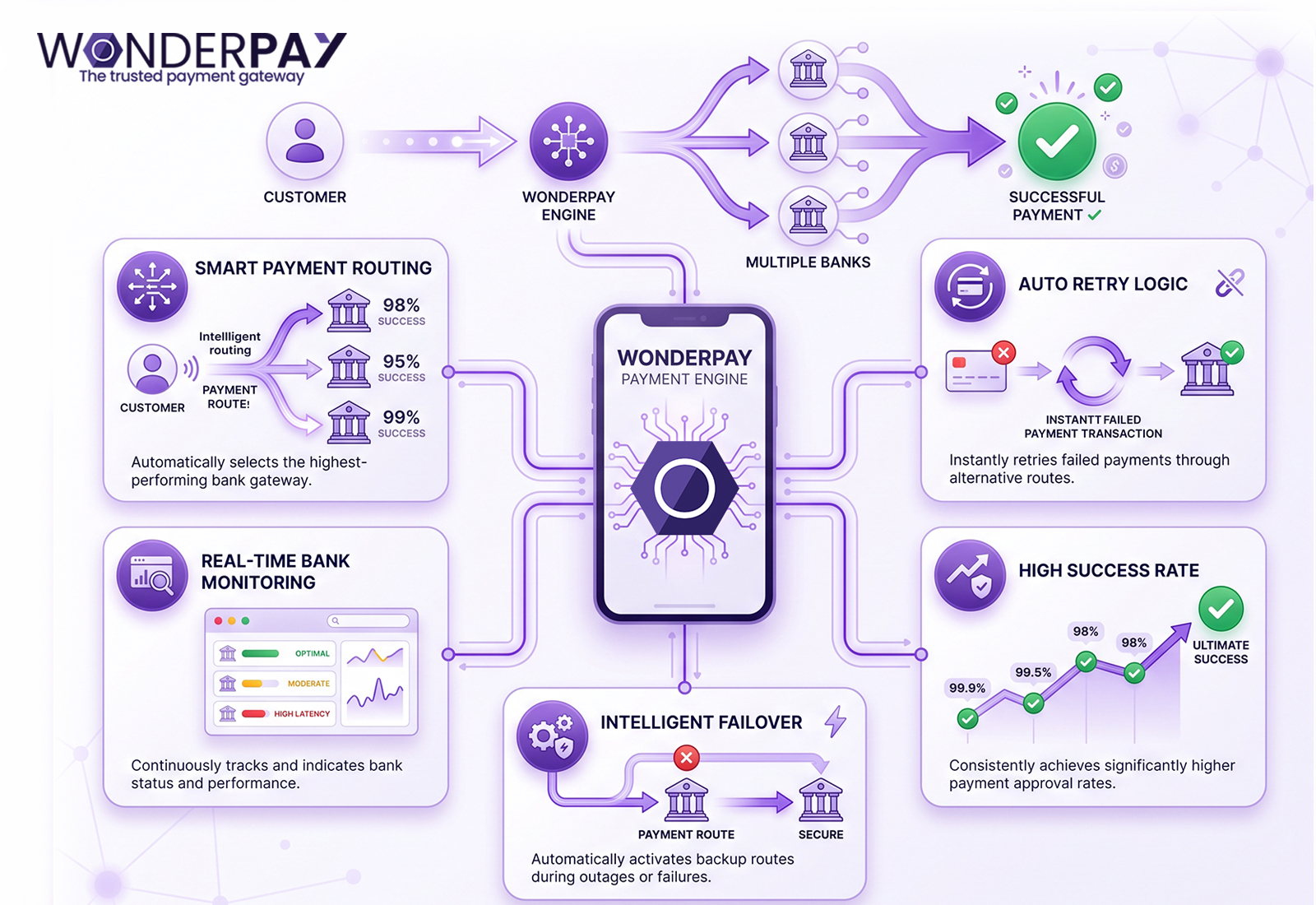
These payment failures are a huge bottleneck for modern businesses, resulting in abandoned carts, lost revenue, and erosion of customer trust. Processing errors are one of the greatest issues where transactions turn off due to technical glitches, network timeouts, and poor integration with banks. Wonderpay eliminates these weaknesses with a secure, reliability-focused advanced payment gateway. Wonderpay dynamically routes transactions, fails over to multiple banks, and detects downtime live. We have smart configurations that coincide with high processing success rates, low friction in the checkout process, and consistent fluidity in digital payments.
In digital commerce, a payment failure is simply an incomplete transaction; one where money does not move from payer to merchant. They should be understood in the context of a complex network between customers, issuing banks, gateway merchants, payment processing providers, and acquiring banks that occasionally has its breakdowns.
The crucial component of optimizing payment infrastructure and avoiding revenue erosion is understanding why these drops occur and how they affect a platform.
When an electronic financial transaction fails to complete the transfer of funds from a buyer to a merchant, this is known as a payment failure.
The states of transactions in digital commerce can be delineated into three distinct types:
Successful Transactions: When the funds are debited and settled
Pending Transactions: Where processing delays owing to banking verification processes place these payments into an incomplete state for some time.
Failed Transactions: Which are clearly rejected. These are usually due to Network timeouts, incorrect credentials, underfunded accounts, or outages at acquiring banks.
Impact on Revenue The extremely dynamic digital economy of India means success rates of payments drive profitability and viability. Higher cart abandonment leads to instant revenue loss due to frequent failure rates, resulting in greater cost for merchants through re-acquiring such customers.
Customer Trust After an initial drop, the constant interruption and increasing time to checkout will make customers lose trust, leading to users migrating to another platform.
Business Growth When it comes to long-term growth, maintaining a strong transaction success rate is essential for continuous customer retention and the most efficient operations.
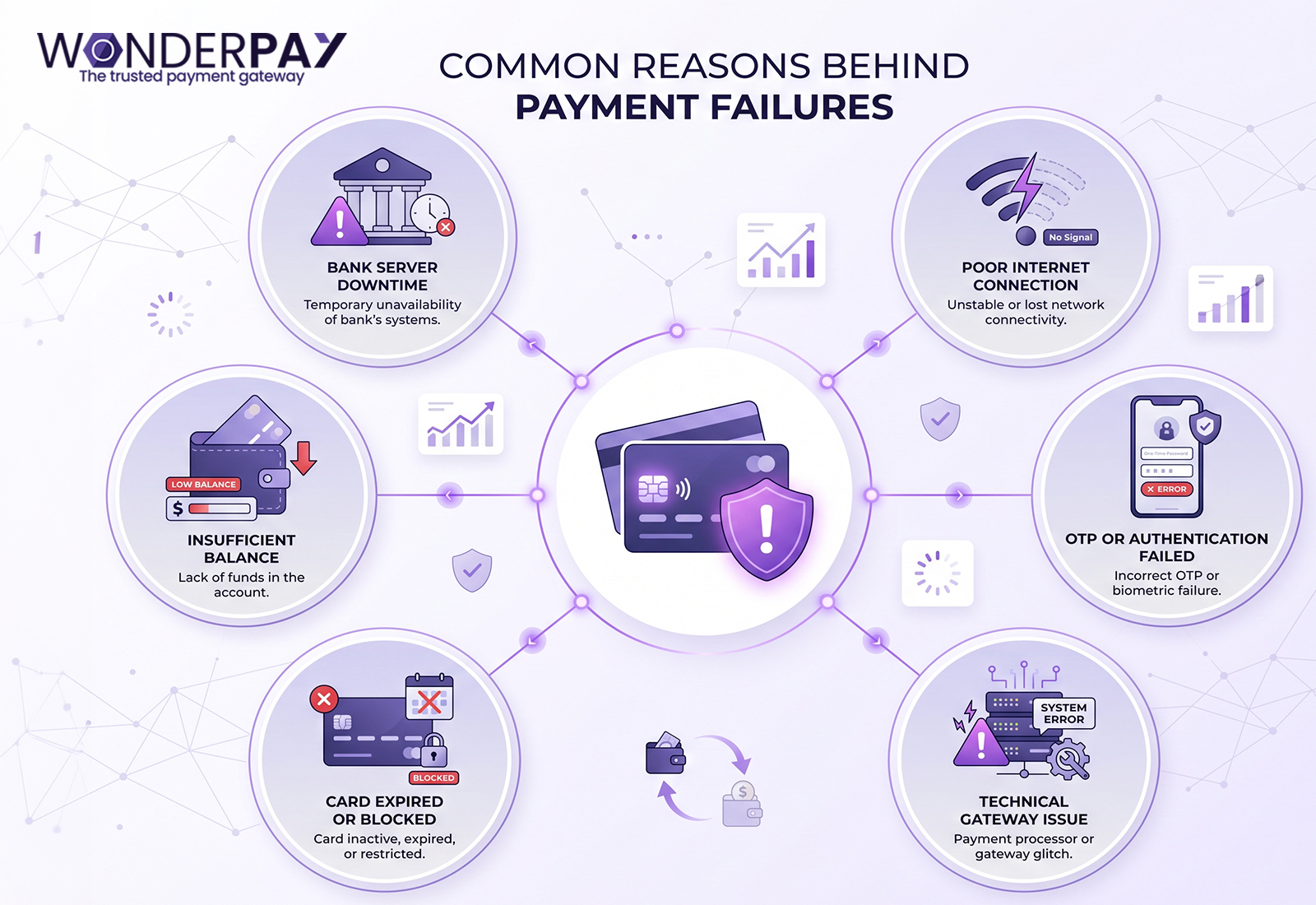
A payment failure happens when the digital transaction fails to run across this very complex authorisation path from merchant to payment gateway, onto the acquiring bank, then to the card network and finally the issuing bank. Identifying these frictions allows organisations to execute best-practice optimisations for recapturing those sales.
Active payment processing often breaks communication channels due to unstable network conditions.
Poor Internet: Micro disconnections in mobile or broadband networks break data traffic during payment.
Banking Server Downtime: This can be planned or unplanned, but when a Bank server goes down for maintenance, those transactions get blocked since verification is stopped at the bank.
A major reason for authorisation rejection is human error in data entry.
Wrong Card Information: Incorrect CVV, expiry date, or typed the wrong primary account number.
Incorrect OTP: Expired, wrongly entered, or not received OTP for two-factor authentication.
Expired Cards: Transactions made by payment cards past their operational expiry date.
The issuing banks automate protections and rules on the accounts that prevent certain transaction requests.
Daily transaction limits: The bank places limits on transfers or counts of daily transactions per account.
Insufficient Balance: The funds available in the account are less than the total transaction fee.
Fraud Detection Triggers: External spending patterns that look suspicious, access at another location, or being blocked by flagged merchant categories from approval.
Inadequate payment software infrastructure can lead to transaction drops during the middle of a process.
Gateway Downtime: Unexpected outages due to hardware failures or overloading of the payment gateway infrastructure.
API Errors: Errors during communication or due to payload mismatch between the merchant’s software and gateway.
Session Timeout: Security procedures that terminate non-completed payment sessions.
Increased friction in the user interface drives customers away from hitting transaction completion.
Slow Checkout: Increase in page latency driving shoppers to abandon pending payments.
Too Many Payment Steps: Multi-screen verification paths that frustrate users.
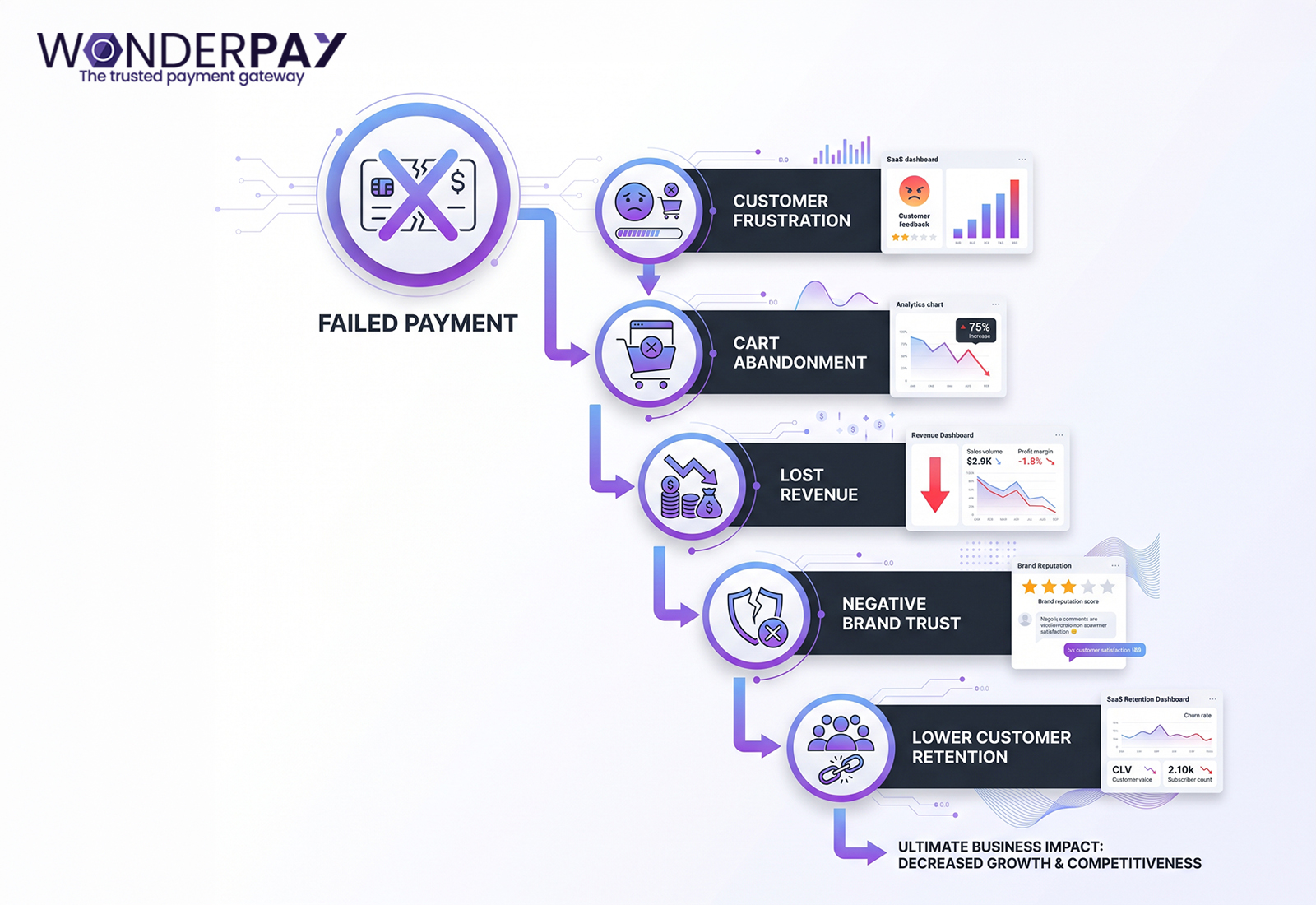
Modern enterprises suffer severe financial and operational damage due to payment failures. In this case, systemic payment drops go beyond interrupting a single transaction and compound the negative impact through the entire customer journey and brand ecosystem.
If a transaction is declined during checkout, it leads to an immediate and irreversible hit on the merchant’s top-line revenue. This lost revenue is a direct hit to margins and wastes the marketing spent acquiring the shopper.
Checkout conversion metrics are heavily suppressed by bounce backs from persistent technical declines. Even when high-intent traffic gets to the payment gateway, transaction errors that go unresolved drop the conversion rate as potential customers are unable to complete their orders.
The inbound support tickets and complaints then come in massively when there are transaction errors. Customer service teams waste time and resources on investigating failed debits, pending authorizations, and refund inquiries.
Checkout disruptions are the leading cause of abandonment by cart. If checkout takes too long or if customers get a broken error screen, they often give up without even trying to enter the payment details again.
The payment process, however, is a crucial moment in the buyer journey, and an unreliable registration can lead to immediate frustration. In modern times, friction in checkout serves counter to expectations of convenience in digital commerce.
Consumers who have a checkout failure are much less likely to come back to the platform. One poor payment experience damages user trust, pushing long-term customers to turn to more reliable alternatives.
Continuous technical failures tarnish the perception of the organisation in the market. Payment processing errors are often considered a reason for poor platform security or reliability, leading to negative reviews and brand trust issues.
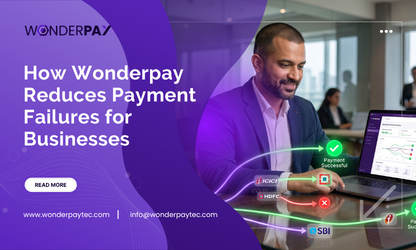
Wonderpay uses intelligent payment routing, proprietary bank-grade infrastructure, and real-time multi-bank failovers to optimize the processing of payments. Wonderpay is designed to reduce transaction dropouts by seamlessly bypassing bank server downtimes, avoiding latency and maintaining high processing success rates on every channel.
With smart transaction routing and a resilient infrastructure, Wonderpay guarantees high authorization rates.
Intelligent Routing: A real-time, auto-routing engine that monitors which specific banking path the transaction should use based on success rates.
Auto Failover: Automatically switches transactions to secondary banking rails in the event of primary server loss.
Providing a wider variety of payment rails means when one fails there is an option immediately available to a buyer.
UPI: Direct support for UPI instant collections and QR payments.
Credit Cards: Tokenized processing of Visa, Mastercard, RuPay and American Express.
Debit Cards: Integrated with all major card-issuing banks in India.
Net Banking: access to more than 50 public and private banking networks across India.
Wallets: Integrated with popular digital wallets.
Instant Switching: The customer can switch to a different payment mode immediately without losing any session data.
Eliminating checkout disruptions through optimized codebases and banking connections.
Reduced Latency: Sub-second API response times reduce checkout latency as well as network drops.
Reliable Handling: Designed to process high volumes of transactions with maximum uptime
Smooth Checkout Experience: Optimized UI layouts reduce friction and help buyers move through payment steps.
Strong compliance standards protect sensitive buyer documents and stop the block on authorization.
Encryption & Tokenisation: Bank-grade data protection compliant with all RBI security mandates.
Secure Authentication: Smooth 2FA and OTP verification workflows.
Fraud Prevention Mechanisms: AI powered risk-based screening to halt fraudulent orders without declining a legitimate order
Safe Payment Environment: PCI DSS compliant infrastructure to manage end to end transactions.
Merchants can easily set up secure checkout environments and require minimal technical effort.
Developer-Friendly APIs: Quick implementation using well-documented REST APIs and SDKs.
Quick Onboarding: Swift KYC processing to bring businesses online in record time.
Seamless Website & App Integration: Pre-installed plugins for main e-commerce platforms and mobile frameworks.
Advanced analytics tools offer immediate insights into transaction metrics.
Instant Payment Updates: Webhooks provide real-time status updates for transactions.
Better Visibility: An all-in-one dashboard to see the status of approvals, declines and settlements.
Faster Issue Resolution: Instant visibility means merchants can resolve technical or bank-side drops.
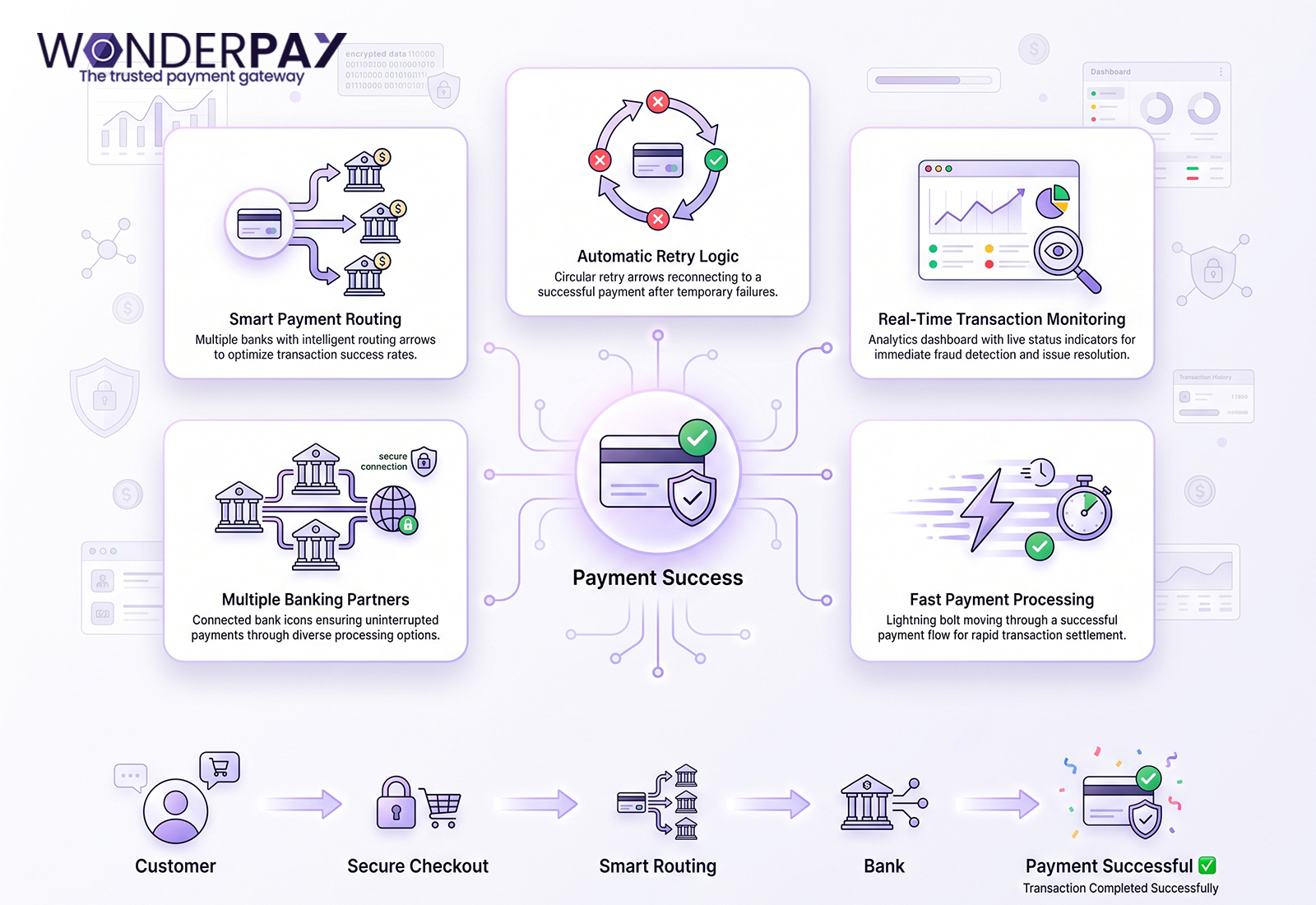
To reduce transaction drop-offs, boost authorizations, and maintain consistent revenue streams, it is crucial to implement proactive measures throughout the entire checkout process. Adopting technical and operational optimizations helps build a resilient payment infrastructure.
Offer Multiple Payment Methods: Ensure that there are payment alternatives such as UPI, cards, and net banking, while preventing the inability to switch if one option fails.
Keep Checkout Simple: Avoid unnecessary form fields, checkout steps to avoid user error and cart abandonment.
Ensure Website Speed: Make sure that the site is fast and that it does not time out when processing transactions.
Monitor Failed Transactions: Keep a check on bank or API failure metrics and patterns regularly and solve the problems quickly.
Use a Trusted Payment Gateway: Work with trusted payment service providers such as Wonderpay with high uptime, smart routing and dynamic failovers.
Keep Payment Systems Updated: Maintain up-to-date APIs, security patches, and SDK integrations to ensure smooth processing.
Educate Customers on Correct Payment Details: Ensure correct checkout using clear directions for OTPs, card numbers, and CVVs to minimize human error.
Choosing a payment infrastructure is critical for scaling digital businesses. Wonderpay’s robust, safe & scalable payment landscape enables brands to efficiently reduce transaction drop-off and optimize checkout conversions.
Reliable Payment Processing: Uses intelligent dynamic routing and auto-failover to maximize payment transaction success during high traffic.
Secure Infrastructure: Fully compliant to RBI data security standards and PCI DSS guidelines to ensure secure transactions and sensitive transaction information.
Business Friendly Integration: REST APIs, SDKs and pre-built plugins for developer-friendly, quick and hassle-free checkout deployment.
Better Customer Experience: Provides faster checkout options and various payment methods to minimise friction and prevent cart abandonment.
Scalable Payment Solutions: Can manage sudden surges in transactions without affecting system availability and performance.
Suitable for Startups, SMEs, and Enterprises: Designed for businesses of all sizes with tailored features and flexible architectures to accommodate their evolving needs.
Related reads: Why choose Wonderpay for businesses?
Failures to make payments directly reduce income, raise operating expenses, and damage hard-won consumer confidence. Wonderpay removes crucial checkout bottlenecks to maintain transaction efficiency by combining dynamic multi-bank routing, intelligent failovers, and PCI DSS compliant security. Increased authorization rates, smooth user experiences, and long-term company growth are all guaranteed when a robust payment gateway is partnered with.
Take charge of your conversion funnel and safeguard your bottom line right now by integrating Wonderpay to provide dependable, seamless checkout experiences for each and every client.
Want to be a part of the Wonderpay community? follow us on:
Youtube : https://www.youtube.com/@wonderpaytec
Instagram: https://www.instagram.com/wonderpaytec
LinkedIn : https://in.linkedin.com/company/wonderpay-technologies-pvt-ltd
Facebook : https://www.facebook.com/wonderpaytec
Twitter : https://x.com/wonderpaytec
An online payment transaction may also get failed due to insufficient balance in the account, incorrect card or UPI details, expired cards, bank server issues, poor network connectivity from either end of the gateway or OTP verification errors as stated by fraud prevention checks. With a trusted payment gateway, businesses can provide seamless and secure transaction processing and minimise payment failures.
To lower payment failures, companies can try testing several methods of payment, facilitating an easy checkout process, tracking unsuccessful transactions, keeping a fast website speed and so on. The overall payment success rate and customer satisfaction are also enhanced through regular system updates as well as a secure payment infrastructure.
Yes, payment gateway improves the payment success rates. The best payment gateway provides safe transaction processing, solid infrastructure, very little downtime, and multi payment methods. All these features help minimising transaction failures during the checkout process and enable businesses for completing successful online payment.
Wonderpay brings us payment success with secure payment processing, various payment methods to choose from, hassle-free transaction handling and easy checkout. With its scalable infrastructure and business-friendly integration, it reduces payment failures enabling businesses to deliver a faster, safer and more efficient digital payments experience for their customers.
Providing multiple payment services allows customers to select their desired method of payment, hence increasing the chances of success. In the event that one method of payment fails, then another option can be available without delay, minimizing payment failures and cart abandonment, as well as providing a much better customer experience with a more reliable online payment gateway.

“A fintech content specialist with expertise in financial technology, digital banking, and emerging market trends, Kanisha Mathur is skilled in crafting SEO-friendly, research-driven content that transforms complex financial concepts into engaging and accessible insights. Combining analytical precision with compelling storytelling, the writing delivers value to both industry professionals and modern digital audiences.”