RBI Repo Rate Hike to 5.50%: From Rising EMIs To Smart Cash Flow Management
October 7, 2026
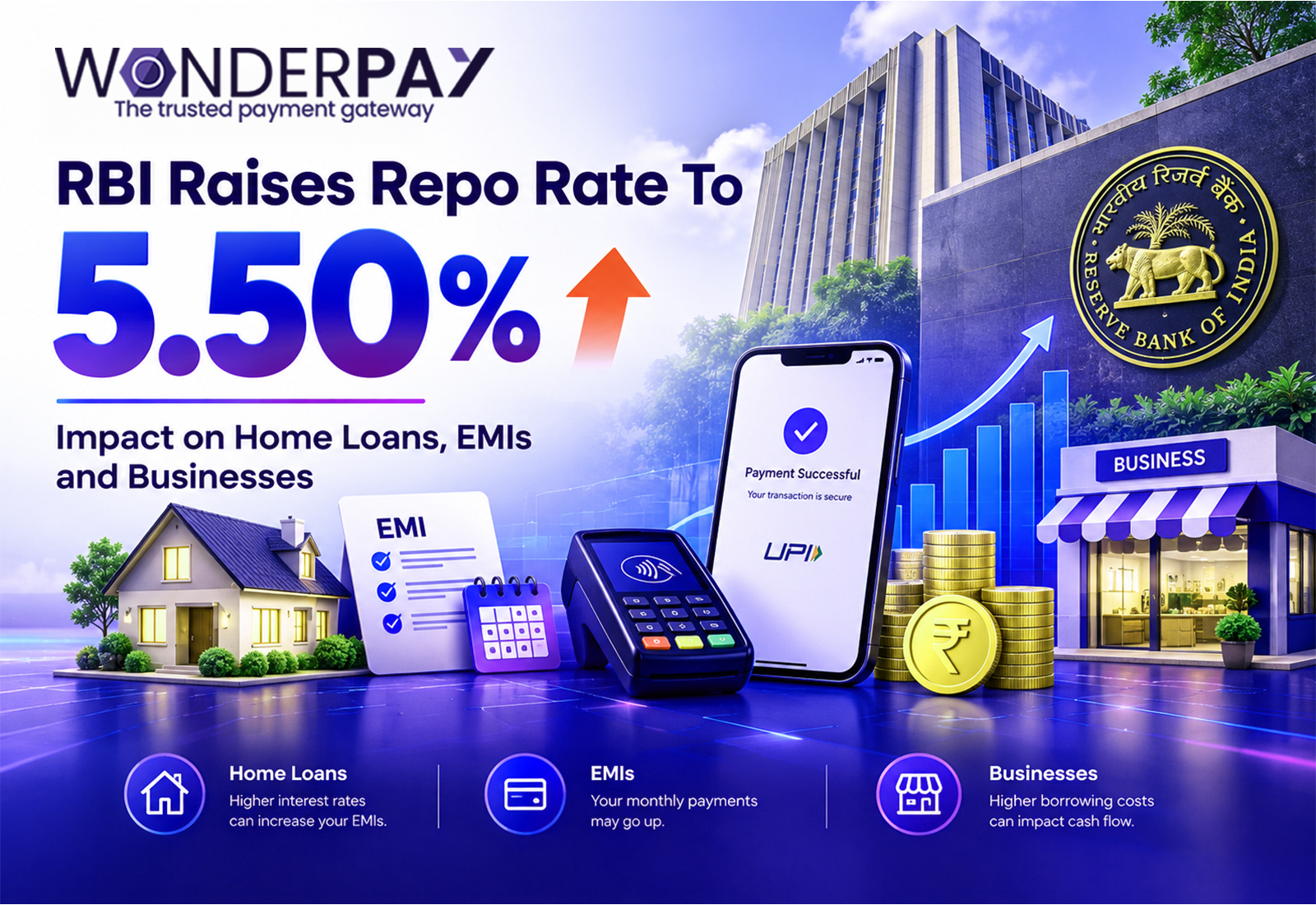
A 25 basis points change feels small in a spreadsheet. But when that change is applied to millions of loans, credit lines, and business accounts, it gets a whole lot bigger.
The repo rate has been hiked from 5.25% to 5.50%, bringing back attention to borrowing costs as well, through a monetary policy statement by the Reserve Bank of India (RBI). In a simultaneous move, the Central Bank upgraded its GDP growth forecast by 40 basis points to 7.1%, signaling stronger optimism on India’s economic growth.
For households, the leading immediate concern is whether home loan EMIs will go up. The more important question for businesses is what the costs of short-term borrowing will be, and how well they can manage working capital.
What does it mean when the repo rate is raised, and how can a borrower or businesses prepare for it?
The most recent monetary policy provisioning transcends financial markets. The policy rate can take months to trickle down to bank interest rates and corresponding rates on loans.
This has also allowed the RBI to raise the repo rate by 25 basis points from 5.25% to 5.50%.
At the same time, the repo rate refers to the interbank rate at which eligible banks borrow money from RBI against securities. As this rate increases, the cost of funds for lenders goes up, which can affect lending rates on different categories of credit.
To consumers this can translate into higher borrowing costs. For companies that use working-capital lines or other short-term credit, it raises the expense of remaining liquid.
A 25 basis point seems small, but borrowing costs are applied to big numbers over long time periods.
Even a slight variation in interest rates means a difference of thousands of rupees over the term of several years for home loans which can run into lakhs. Likewise, companies who utilize credit lines periodically may pay more if these rates trend upward.
This raises the importance of cash-flow management in high-rate environments.
For millions of homebuyers, the most relevant question is simple and easily answered — Will my EMI go up?
The answer is contingent upon the type of loan and how the lender resets its interest rate.
If interest rates change substantially as a result of a change in the benchmark rate, then you will be notified that your floating-rate home loans can be re-adjusted.
This could subsequently lead to an increase in the monthly EMI, should the lender not change your loan tenure. The other could be the lender extending the tenure and making only a marginal change in the EMI.
The tangible impact will depend on the outstanding principle, remaining tenure, benchmark, spreads and resets set by the lender.
Borrowers planning to avail a home loan may also have to factor higher borrowing costs.
The same loan amount can cost more every month if rates are higher. This means that, before arriving at their borrowing amount, potential homebuyers should first assess their EMI under varying-rate scenarios.
It is better for borrowers to not go by maxing the budget according to the maximum loan eligibility and instead have some cash left after accounting for interest rate changes as well as other household expenses.
Not every borrower will see the same EMI rise. Now, the impact will depend on how much loan is taken, at what interest rate, and with what tenure remaining.
Take for instance a borrower who has ₹40 lakh floating-rate home loan. If the tenure remains the same but a benchmark revision leads to an increase in the applicable lending rate, then EMI will go up.
On the other hand, the duration to repay loan might increase also where borrower can continue paying an equivalent EMI.
That is the reason borrowers should take their outstanding balance and tenure as per reality in computing the effect rather than applying 25-basis-point hike on their EMI immediately.
The repo-rate hike does not reflect a similar change in every home loan EMI on that very day.
The timing of such a revision shall depend upon the lender benchmark and reset frequency. Final rates are also affected by the spread applicable to their loan and other terms.
As a result, borrowers need to look for their lender’s messaging to know how the latest movement in rates will affect them.
This repo-rate hike is one aspect of the most recent RBI announcement. The GDP growth outlook has also been revised upward by 40 basis points to 7.1% from previously forecasted levels.
The increase in the GDP forecast points to the RBI’s earlier expectation of stronger economic activity in India compared with previous estimates.
Improved economic growth can help strengthen consumption, investment and business activity. But growth outlooks should be taken in consideration with inflationary, global economic and other risks.
On the one hand, higher interest rates and a stronger growth forecast seem like contradictory developments.
But monetary policy decisions are a case of simultaneous equations. This means that, the RBI may continue to tighten financial conditions (to control inflation or other risks) while expecting decent underlying growth momentum.
This makes financial discipline important even when the macroeconomic outlook remains favourable for businesses.
This will have a knock-on effect beyond just the home loans. Borrowing costs may impact businesses that use credit lines, overdrafts or short-term debt for working capital.
If external financing gets more costly, companies may have to pay more to keep the same level of borrowing.
It can be especially important for companies that routinely take on debt to manage inventory, payrolls, payments to suppliers or holes in receivables.
As reliance on short-term borrowing increases it is even more vital that financing costs are monitored.
Working capital that is dormant or trapped becomes more expensive in a high-rate environment.
Businesses no longer have to rely primarily on credit for filling cash-flow gaps and can devote their attention to accelerating money into their accounts, while also increasing the efficiency of their payment operations.
This translates into an ability to obtain faster credit lines, reduce delays in settlement as well as real-time visibility and tracking over the movement of funds both going out and coming in.
Stronger rates can lead to a more cautious style of cash flow management amongst businesses. Here are three operational improvements to mitigate reliance on debt.
Decreasing payment and settlement delays helps businesses get to their money quicker. Smaller cash-conversion cycles make it less necessary to borrow just to meet temporary gaps.
Automated reconciliation can help in speeding the matching of payments and payouts, reduce manual errors and provide visibility to available funds.
With better cash-flow forecasting and faster collections, businesses can avoid much of the cost of paying interest to fund liquidity gaps that could have been avoided in the first place as working capital is kept available.
While RBI raised repo-rate from 5.25% to 5.50% that also grows the borrowing value for homebuyers and businesses. However, the economic momentum continues with the 7.1% GDP forecast signs. For borrowers, a revision on their EMI, interest rate and repayment term are sufficient steps; for businesses, rapid cash conversion monitoring and better working-capital management matters. Less business attention on extra credit dependence on protect finances in a high-interest environment. By being little ahead of cash flows, loans, and liquidity boxes could help households and businesses in adjusting to borrowing costs.
Want to be a part of the Wonderpay community? follow us on:
Youtube: https://www.youtube.com/@wonderpaytec
Instagram: https://www.instagram.com/wonderpaytec
LinkedIn: https://in.linkedin.com/company/wonderpay-technologies-pvt-ltd
Facebook: https://www.facebook.com/wonderpaytec
Twitter: https://x.com/wonderpaytec

“A fintech content specialist with expertise in financial technology, digital banking, and emerging market trends, Kanisha Mathur is skilled in crafting SEO-friendly, research-driven content that transforms complex financial concepts into engaging and accessible insights. Combining analytical precision with compelling storytelling, the writing delivers value to both industry professionals and modern digital audiences.”