IMPS Transfer: Benefits, Limits, Charges & How It Works
September 22, 2026
No more waiting for banking hours or worrying about delays for sending money. You can transfer funds instantly and at your convenience anytime, including during weekends and bank holidays. Using IMPS Transfer. Immediate Payment Service (IMPS) is a 24×7 instant interbank electronic fund transfer service to the customers and one can transfer money instantly into another bank directly.
From paying a bill to sending money abroad or even making an urgent transaction, IMPS transfers are one of the simplest and most convenient ways you can use daily for making payments. According to NPCI (National Payments Corporation of India), IMPS is also used for most of the banking purposes, where the IMPS fund transfer limit is up to ₹5 lakh per transaction.
How does IMPS work in banking, its top benefits, & limits & charges on transactions? All you must know about IMPS money transfer can be found in this impressive guide. (Source)
Immediate Payment Service (IMPS) is a real time electronic fund transfer service that enables customers to transfer money between banks instantly and easily. You can IMPS transfer using the banks that offer this service through mobile banking, internet banking & ATMs too. IMPS service provides 24x7 services on Sundays and even All Indian bank holidays unlike old banking methods which depend on working hours. It is the most comfortable solution for urgent payments along with daily expenses as well as sending money to family or friends.
To make the payment, an IMPS transaction is already raised with details such as beneficiary’s account number and IFSC code or any other identifiers supported in its channel. Upon successfully approving the transaction, IMPS fund transfer occurs electronically and a sum is transferred to the beneficiary account. IMPS is an integral part of Digital payment infrastructure in India as it provides fast, anywhere and anytime banking. Whether it is a simple payment or an urgent IMPS money transfer, it facilitates fast and easy banking.
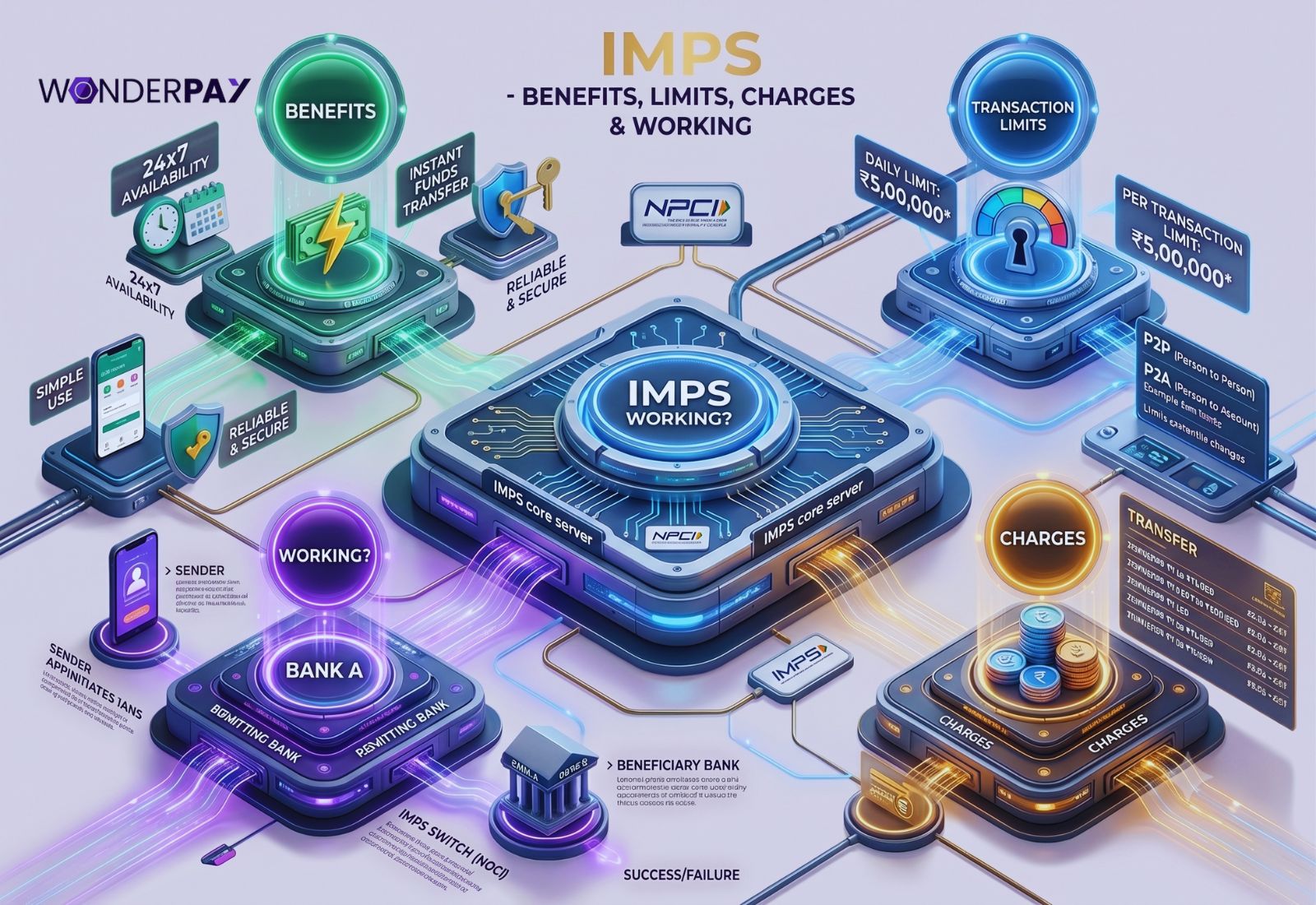
An IMPS Transfer is processed through multiple checks between the customer bank, NPCI payment network and beneficiary bank. When a customer initiates a transaction through IMPS, the originating bank verifies information related to payment and authentication and forwards the request through the IMPS network. The beneficiary bank processes the request, and credits the recipient’s account.
This collaborative process makes an IMPS fund transfer both rapid and electronic recordable. The IMPS service was still operating on a scale of 364.34 million transactions worth ₹7,11,704.35 crore according to NPCI statistics for July 2026. (Source)
1. Select IMPS: Choose either directly or through shortlisted channel offered by the bank, such as mobile app.
2. Enter the Amount: Depending on the status of each transaction enter an amount you want to send.
3. Authenticate: You also need to Authorize the IMPS Money transfer depending upon what method your bank is using for authentication.
4. Bank Validation: Comes from bank to validate the payment request and sending it over IMPS network.
5. Beneficiary Credit: The receiving bank accepts the request and credits to your Beneficiaries account.
What you will need depends on how your bank allows you to transfer. IMPS- Beneficiary account number & IFSC are enough to start a banking transfer. Participating banks support mobile-number-and-MMID method.
Initiating IMPS Transfer one of the reasons IMPS became so popular is that it provides banks multiple options for initiating IMPS transactions. Select the mode you want, enter the necessary beneficiary information, enter the amount and approve payment. This request is then passed through immediate payment service via payment channel supported by the bank. Before confirming an IMPS fund transfer, always verify the beneficiary’s details and amount to ensure that you are not transferring money to a wrong account.
Login securely with your banks mobile app. Go to the fund-transfer or payments section, Select or add beneficiary and enter necessary details and amount then go to IMPS. Please confirm with your bank authenticating the IMPS money transfer. Save the transaction number to use as a reference for future purposes.
Log on to the official website of your bank and click on the fund transfer option. Select IMPS, select the beneficiary, enter their account number and the amount to be transferred and then confirm on-screen details. Provide the required authentication to carry on with the IMPS transaction. Save the confirmation details.
Insert debit card into IMPS-enabled ATM and select fund-transfer option. Select IMPS, fill in the necessary beneficiary details and amount, check all the information entered and make your payment. This offers one more easy medium in day to day IMPS service in banking.
The IMPS transaction limit is what sets the maximum amount you can send in one transaction through an IMPS Transfer. For IMPS transactions, the overall maximum limit is usually ₹5 lakh excluding charges as per NPCI. Nevertheless, each lender can define their own minimum thresholds that are lower for a specific account type or banking channel or defined by other internal policies. Hence, the limit you can actually get is different from one bank to another.
You must check the limit that your bank displays before entering an amount for an IMPS fund transfer. Certain banks even have a separate limit on mobile banking, internet banking or ATM-based usage. The IMPS or Immediate Payment Service can be used to remit amounts within the set limit in you bank channel up until now, it is thus ideal for remittances between your different institutions. Make sure you confirm the present limit of your bank before starting an IMPS money transfer.
The IMPS Transfer fees vary from bank to bank, value of the transaction and method used for performing the payment. Some banks provide IMPS free of charge through certain digital channels but some banks levy a nominal fee for an IMPS transaction. Applicable charges may also depend on the type of account but also by the currently prevailing fee structure of the bank.
Always read the most recent schedule of charges on your bank’s website before an IMPS fund transfer to see what fee is applicable. Whenever any kind of charges are made, it tends to be shown during the course of making transactions so that you can see the cost before executing payment. Applicable taxes (e.g., GST) may also be levied on the service charge for selected transactions. There is no single charge for all IMPS money transfer as the pricing of IMPSs fee is decided by individual banks. Doing so highlights database-specific costs and plans your IMPS in banking transactions much more clearly.
If you require a quick and accessible way of moving money, then the Immediate Payment Service has various practical advantages for consumers. The IMPS Transfer is a good mix of speed, convenience and flexibility which makes it viable for both routine payments as well as urgent fund requirements.
One of the more memorable feature of use in an IMPS transaction is that it can be performed anytime outside the conventional banking hours. Based on the service agreements with their banks, customers are free to initiate transfers on weekends and bank holidays.
The existence of an IMPS fund transfer enables you to process payment in a prompt manner as it allows funds to reach the beneficiary before any waiting period like other traditional transfers.
You already have a better understanding of how the IMPS service is supported by digital and banking channels, and transfer money can be successfully made without any visit at bank branches. Besides, this simplicity makes IMPS money transfer a suitable solution for regular payments.
To secure their customers in an IMPS Transfer, banks take authentication and transaction-validation measures. Still the users should check for details of beneficiary for final payment.
Banking IMPS can be availed by mobile banking, internet banking and eligible ATMs which provide customers the flexibility to use any kind of channel they wish in order to initiate a transfer.
Although an IMPS Transfer is designed to be instantaneous, a transaction can sometimes fail due to issues such as technical error, improper beneficiary information, or maintaining temporarily with the bank or payment network. If you are aware of the next step, you can handle a struggling IMPS transaction without worrying unnecessarily.
There can be several reasons for an IMPS transaction failure, such as incorrect account information, inactive benefactor account, less amount, bank-server problems/network disruptions or exceeding the maximum limit during a relevant amount transfer. To avoid double payments, you need to check the beneficiary details and transaction status before doing another IMPS fund transfer.
If your account is debited but the recipient does not receive the IMPS money transfer, check the transaction status and reference number in your banking app or on your statement. Do not send the money again immediately. Then, if the money does not return automatically after a certain period of time, contact your bank with the transaction reference and seek assistance with an IMPS service transaction that was unsuccessful.
Yes an IMPS Transfer is supposed to serve as a method of making transmission of money between banks that participate in which it is safer. Immediate Payment Service adopts transaction-validation and banking authentication processes in order to protect payment requests in a more secure manner. However, the enhanced security of IMPS Transaction is also dependent on users. Retrain to double-check the beneficiary account number IFSC and transfer amount before doing an IMPS fund transfer.
Now, whether you are using IMPS for money transfer or any other payment option to deposit cash into a bank; make sure that never ever offer your OTP, PIN password and financial information to anyone claiming to be your banker. Only perform transaction with IMPS service if you use official bank mobile application, website, or official ATM of your bank. You should track transaction notifications and check your account statement from time to time. By combining the security aspects of IMPS with prudent digital banking practices, customers can use IMPS more confidently.
IMPS Transfer has enabled sending money in an incredibly fast, convenient and easily accessible through multiple banking channels. Know the essentials. Whether you want to know about the IMPS transaction process or check transfer limits, charges and security measures, being aware of the importance can help you avail this service with confidence. IMPS help you a lot when we want to send an immediate IMPS fund transfer and being unable to wait for the normal banking hours. You can use the IMPS money transfer finder flexibly for your daily financing needs be it a mobile banking, internet banking or ATM. Other than checking the beneficiary details, it is advised to keep banking safe in a proper manner while availing IMPS.
Want to be a part of the Wonderpay community? follow us on:
Youtube: https://www.youtube.com/@wonderpaytec
Instagram: https://www.instagram.com/wonderpaytec
LinkedIn: https://in.linkedin.com/company/wonderpay-technologies-pvt-ltd
Facebook: https://www.facebook.com/wonderpaytec
Twitter: https://x.com/wonderpaytec
Yes, the IMPS (Immediate Payment Service) should be available all through the day including weekends and bank holidays. Thus, an IMPS Transfer comes in handy when you need to transfer funds within Banking hours. Note that the availability of IMPS specific channels is determined by banks and their service policies.
According to NPCI, the maximum amount that can be transferred through IMPS is ₹5 lakh per transaction but individual banks may impose their own limits which are lower. Your limit also varies by banking channels or types of accounts. All India Bank currently operates near exactly the same accordance of some banks have higher threshold but this should be checked before initiating funds transfer.
IMPS money transfer is meant to be real time, so it can generally be expected that successful authorisation will result in the beneficiary receiving the funding shortly thereafter. Real credit will differ based on the banks that and status of the transaction. If it was debited and not credited then look for transaction status and contact your bank if needed.
IMPS charges vary according to the transferring amount, banking type and account type and are set by individual banks. While certain banks may offer IMPS free of cost via select channels, there are a few banks that might also levy a fee in addition to applicable taxes. Check out with the latest fee structure of your bank for possible IMPS Transfer before proceeding.
Depending upon the method supported by your bank, the details required for an IMPS money transfer varies. Generally, you may require the beneficiary account number and its IFSC code. Maybe other identifiers are supported for some channels. Verify that the beneficiary details are correct while confirming an IMPS transaction to avoid sending money mistakenly.

“A fintech content specialist with expertise in financial technology, digital banking, and emerging market trends, Kanisha Mathur is skilled in crafting SEO-friendly, research-driven content that transforms complex financial concepts into engaging and accessible insights. Combining analytical precision with compelling storytelling, the writing delivers value to both industry professionals and modern digital audiences.”