What Is Deferred Revenue? Meaning, Journal Entries & Benefits
October 31, 2026
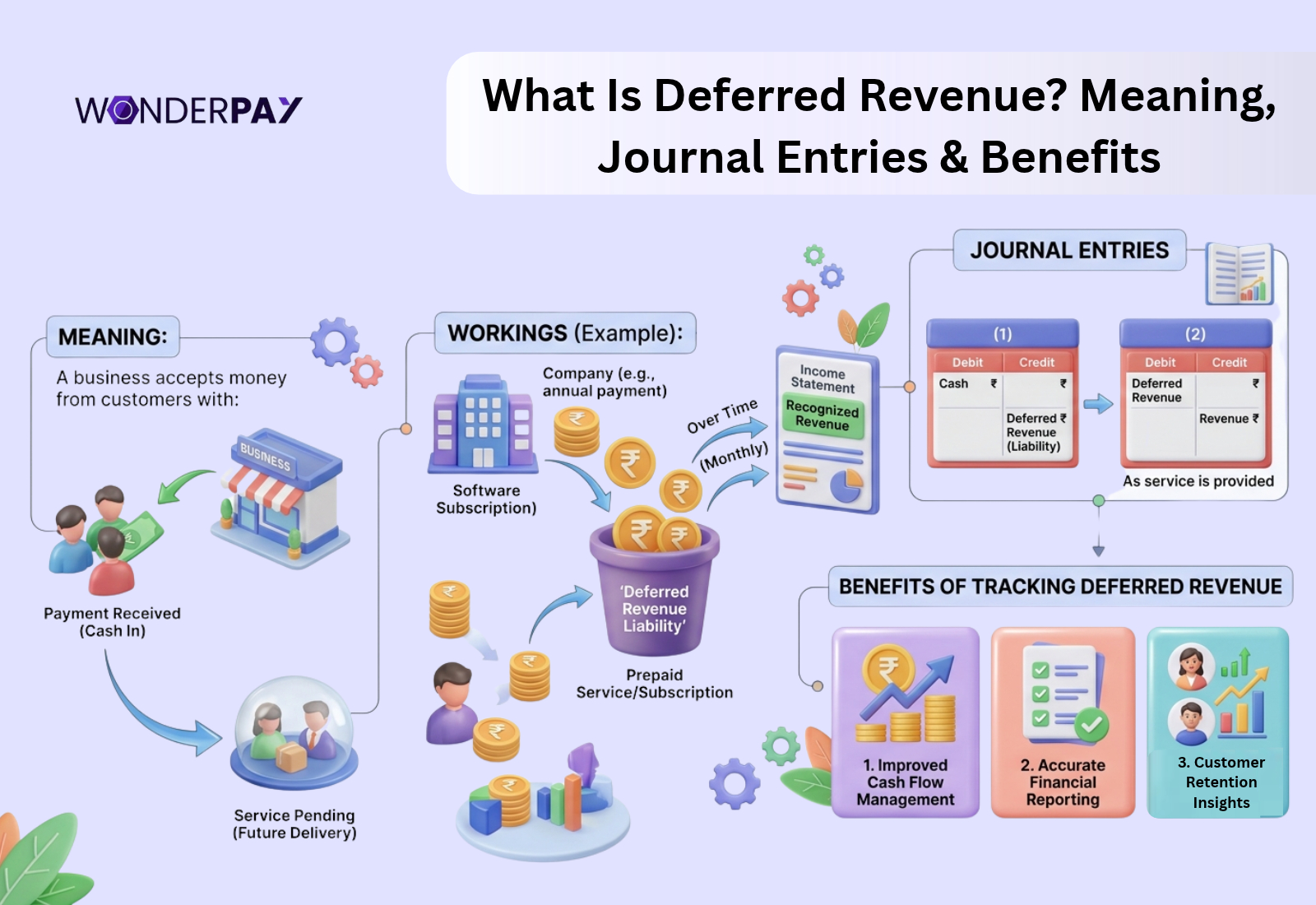
Deferred Revenue is an accounting term used by organizations to track money received from customers prior to providing products or services. Although the organization has collected cash for products or services, the revenue associated with these transactions cannot be recognized until after the organization provides the product or service. This is due to the fact that the organization continues to owe its customers the product or service.
Deferred revenue is recorded as an obligation in the portion of the deferred revenue balance sheet. It is then recognized as revenue over time as the company satisfies its contractual commitments. By learning about the entry for deferrals, you will be able to tell the difference between deferred revenue and similar deferred rent accounting entries like accrued revenue.
In this article, you will find out what deferred revenue is; how to create the entries for deferred revenue; some real-world examples of deferred revenue; and several other deferred revenue-related accounting terms, such as deferred expense journal entry, deferred charge journal entry, deferred cost journal entry, deferred receivable, deferred rent accounting, and deferred rent receivable.
Deferred revenue represents the amount that a business has collected from its customers prior to completing the delivery of the promised goods or services. Because the business is still responsible for completing the contract, it cannot immediately recognize the amounts collected as earned revenue.
Deferred revenue occurs when an organization collects payment for services or products before providing them. Many types of organizations use deferred revenue including subscription-based businesses, insurance providers, educational institutions, and other service-oriented organizations who accept payment in advance. The deferred revenue is typically recognized as a liability until the associated performance obligations are met.
Deferred revenue is understood more clearly by looking at some of its most common features:
Advance Payment: The business receives money before providing goods or services.
Liability Recognition: The payment creates an obligation to the customer.
Revenue Recognition: Income is recognized when a business completes what it agreed to do under contract.
Reporting Financials: Recording correctly guarantees that revenue is reported during the proper accounting period.
Deferred revenue may also be referred to as deferred income or unearned revenue, however, these terms should not be confused with accrued income. Accrued income is typically generated from earned income that has not been collected.
Deferred Revenue principles apply to how companies recognize revenue based upon the completion of a specific performance obligation (or multiple) as opposed to recognizing revenue when a customer pays for goods or services. There are several factors that determine the time frame for recognizing revenue, including the terms of the customer’s contract and relevant accounting standards.
When a company initially receives payment from a customer for goods or services, it records that payment as a liability. Once the company provides those promised goods/services to the customer, the liability will decrease, and the company can then recognize the revenue associated with the transaction.
A company receives 24,000 for a 12-month service agreement. If the service is provided on an equal basis during the entire year and straight-line recognition is deemed appropriate, the company will recognize 2,000 as revenue each month.
This process allows companies to maintain correct financial records and avoid overstating their profits.
Deferral accounting entries are made to reflect advance payments received from customers as well as the recognition of the associated income when it is earned. Deferral accounting entries assist companies in distinguishing between cash received and income generated.
A company has received ₹60,000 from a customer for services to be provided over the next few months.
| Account | Debit | Credit |
|---|---|---|
| Bank Account | ₹60,000 | - |
| Deferred Revenue | - | ₹60,000 |
The bank account will be debited due to an increase in cash. At the same time, deferred revenue will be credited as a result of the business owing further services to the customer.
The company provided ₹10,000 in services to customers over the course of an accounting period.
| Account | Debit | Credit |
|---|---|---|
| Deferred Revenue | ₹10,000 | - |
| Service Revenue | - | ₹10,000 |
This entry lowers the amount of debt owed by the company and acknowledges that the company has received compensation for the work it performed. As a result, there is still ₹50,000 left on the deferred revenue account.
The end of each fiscal year is when companies need to assess their contractual agreements and shipping documentation in order to calculate the amount of revenue they have generated. The purpose of adjusting entries is so that the company’s remaining liabilities reflect those obligations which have not been met.
To avoid errors in financial reporting, regular reconciliations, supporting documentation and the use of the right accounting policies are necessary.
A deferred revenue example will help demonstrate how an advance payment is recorded and then recognized at later dates.
In order to recognize revenue on a monthly basis from an annual subscription of ₹12,000, a software development firm can record the full amount of ₹12,000 as deferred revenue. The firm will then be able to recognize ₹1,000 each month as long as the service is delivered evenly over the entire course of the year.
An insurance company receives the premium for an entire policy year prior to issuing the policy. At the time of receiving the premium, it will record the unearned portion as a liability, which will be recognized as income as the company provides the insurance protection during the year. This method of accounting is consistent with current accounting standards.
A consulting firm receives an upfront payment of ₹30,000 for a specific project. This money is recognized as revenue when the consulting firm meets the conditions specified in its performance obligations. Unearned revenue is then classified as deferred revenue until the conditions are met.
The above examples demonstrate that deferred revenue is used within many types of businesses, and it provides support for producing accurate financial statements.
Deferred revenue represents the remaining obligation of a company to its customers. Deferred revenue is typically listed as a liability on a company’s balance sheet because the company has collected money from its customers, but has not completed the delivery of the items or services that were purchased.
Deferred revenue is categorized as either a current liability or a non-current liability based upon how long it will take to satisfy the obligation and the accounting rules that apply.
Current liabilities: Those liabilities that are expected to be settled by meeting the obligation within either the current liability period or within a typical business operating cycle.
Non-Current Liabilities: Amount related to commitments that will be satisfied in future periods (beyond the current year) and for which non-current status is applicable.
A company that is paid in advance for products or services will have an increase in both cash and liability. After the company has completed what it was supposed to do, then the amount of deferred revenue goes down and the amount of revenue recognized increases.
The reason this is so important is that just receiving money doesn’t always indicate a business has earned something. Proper classification will help ensure that businesses are producing accurate financial reports.
Understanding the difference between deferred revenue and accrued revenue is helpful to business owners when determining how to recognize two different types of revenue.
| Basis | Deferred Revene | Accured Revenue |
|---|---|---|
| Meaning | Payment received prior to earning revenue. | Revenue earned prior to receiving payment or recording cash. |
| Cash Timing | Cash received prior to delivery of service. | Cash typically received after delivery of service. |
| Intitial Classification | Liability | Asset or receivable |
| Example | Payment made in advance for a magazine subscription. | Delivery of services to a client, however, no billing has occurred yet. |
A company that receives a payment for services scheduled for the following month should record deferred revenue. On the other hand, if a company has provided services during the current month, and expects to receive the related payment next month, then they could potentially recognize accrued revenue.
Deferred revenue and unearned revenue are generally used to represent the same accounting concept. Each represents an amount paid by a customer for goods or services that have not yet been provided to the customer.
The terms can be used interchangeably by businesses in their accounting systems. However, in both instances, the liability will remain a liability until the appropriate revenue recognition criteria are met.
Deferred expense is an accounting term used to describe a cost which has been paid or incurred prior to the full benefit of that cost being received or recognized. Deferred revenue is a separate accounting concept which refers to the receipt of money in advance for goods or services to be provided by the company in the future.
A deferred charge journal entry can be used to record qualified expenses that have the potential to produce results in the future. For example, a business pays ₹24,000 for 12 months of rent in advance.
| Account | Debit | Credit |
|---|---|---|
| Prepaid Rent | ₹24,000 | - |
| Bank Account | - | ₹24,000 |
The rent benefit will be consumed on an even basis and as such, the company will recognize ₹2,000 in monthly rent expenses. This will be accomplished through a debit to “Rent Expense” and a credit to “Prepaid Rent.”
When allowed under current accounting rules, a deferred cost journal entry is used to record a deferred cost as an asset. Then, when the associated benefit has been used, or when the deferred cost meets the required recognition criteria, it will be recognized as an expense.
In order to be considered an asset, every prepayment is not a valid prepayment. Organizations should evaluate what type of expense it is, as well as the accounting standards that apply.
The term deferred receivables may be defined differently by different businesses, therefore the definition should be specified within each business environment. Receivables represent what a business expects to receive from customers; however, deferred revenues represent the obligation to provide products or services after a customer pays for them.
A business which has provided its service to a client and is awaiting receipt of the funds from that transaction will record the amount owed to them as an accounts receivable. On the other hand, if a business receives an upfront payment prior to providing the service, they will typically record this as deferred revenue.
The deferred rent accounting process is concerned with the difference between the amount of money paid for rent, and how much rent is recognized as an expense or, in some cases, income. The way this issue should be treated will depend on what the lease states about the payment of rent, and which set of accounting rules are applicable to the situation.
Terms deferred rent receivable and unearned rental income need to be clearly defined. In most cases, when a company has earned rent that has not yet been paid for by the tenant, the company will record this amount as a rent receivable. If the company receives payment for rent before it is earned, the company will typically record this amount as a liability until the rent has been earned.
When a business accepts advance payments for services that it will provide in the future, it should wait until those services are provided before recognizing the payment as revenue. Recognizing advance payments as revenue too soon can lead to an overstatement of income and an understatement of liabilities.
Additional common errors include not making adjusting entries, misidentifying liabilities, and failing to recognize contractual obligations. Maintaining accurate records, reviewing customer contracts on an ongoing basis, and reconciling deferred revenue accounts will assist in improving financial reporting.
Deferred revenue is a vital component of accounting which allows businesses to recognize income at the time they fulfill their obligation as opposed to just at the time they receive payment. The ability to understand the deferred revenue definition, prepare appropriate deferred accounting entries, and accurately classify deferred revenue on the balance sheet helps to provide transparency for all aspects of a company’s financial reporting.
Businesses must also know the distinction between deferred revenue vs accrued revenue, deferred expenses, and other relevant accounting terms. When a business uses proper documentation and follows consistent accounting practices, it can reduce the likelihood of making mistakes in its financial records and keep those records accurate.
Want to be a part of the Wonderpay community? follow us on:
Youtube: https://www.youtube.com/@wonderpaytec
Instagram: https://www.instagram.com/wonderpaytec
LinkedIn: https://in.linkedin.com/company/wonderpay-technologies-pvt-ltd
Facebook: https://www.facebook.com/wonderpaytec
Twitter: https://x.com/wonderpaytec
Deferred revenue is usually a liability because the company has received money for products or services that have not yet been provided to the customer. Once all of the applicable performance requirements have been met, deferred revenue ceases to be a liability.
The most frequent deferred revenue instance would be when a firm receives ₹12,000 for a 12-month subscription. When the firm delivers the service at an equal rate, it will recognize ₹1,000 per month as revenue.
Once the business receives a payment, they will debit cash or bank and credit deferred revenue. Then, when the business has earned that revenue, they will debit Deferred Revenue and credit the appropriate Revenue account.
Deferred revenue is when you receive money before you make it, and accrued revenue is when you make money prior to getting paid, or even before making a record of it. Deferred revenue is typically a liability; however, accrued revenue can be either a receivable (asset) or liability.
Deferred revenue is a current or non-current liability depending upon when the obligation will be satisfied, and what are the relevant accounting guidelines. Deferred revenue represents the amount of money a company owes to its clients for products/services it has yet to deliver.

“A fintech content specialist with expertise in financial technology, digital banking, and emerging market trends, Kanisha Mathur is skilled in crafting SEO-friendly, research-driven content that transforms complex financial concepts into engaging and accessible insights. Combining analytical precision with compelling storytelling, the writing delivers value to both industry professionals and modern digital audiences.”