KYC Is Not Enough: Why Continuous Merchant Monitoring Matters
July 28, 2026
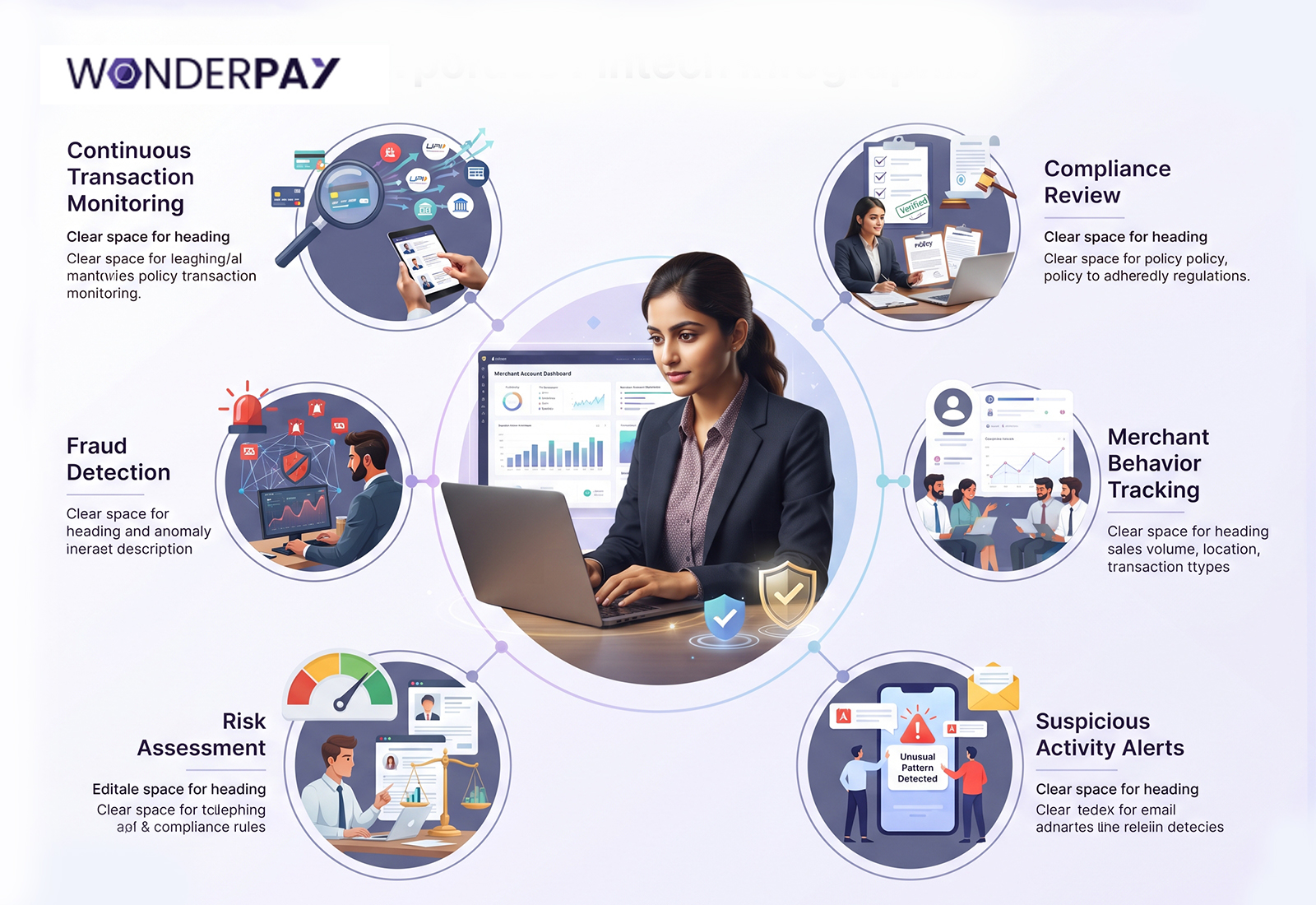
A merchant completes Know Your Customer (KYC) onboarding and then months later turns out to be a financial or compliance risk. With the continuous growth of India’s digitization, payment gateways will have to not only onboard merchants but also manage new risks as merchants grow through their own lifecycle.
KYC is fundamental to compliance, though it provides only a snapshot of a merchant at one point in time. It cannot predict any potential shifts in business behaviour, transaction flow or emerging fraud threats. Continual merchant monitoring is an integral part of contemporary payment risk management, allowing payment providers to enhance compliance efforts, minimize fraud and foster greater trust among all parties in the digital payments ecosystem.
Know Your Customer — KYC is the process we follow to verify and validate merchants before onboarding them by financial institutions and payment service providers. KYC requirements in India are regulated by the Master Direction – Know Your Customer (KYC) Directions, 2016, issued by the Reserve Bank of India (RBI), laying down the customer identification procedures, the extent of customer due diligence, and record-keeping obligations.
The general purpose of KYC is to prevent financial crimes such as identity theft, money laundering, terrorist financing, and abuse of economic services. Payment gateways can establish a better payment system if they verify the identities of merchants before onboarding to meet regulatory standards.
As per the KYC Directions of the RBI, regulated entities have to establish customer identity and perform due diligence before establishing a business relationship with customers.
Merchant verification is more than just gathering identity documents. Payment gateways to ascertain whether the business is registered legally, verify authorised personnel and banking details, and get a better understanding of their business model. These checks decide if a merchant is legally and operationally acceptable before they can be enabled for online payments.
A seamless KYC process also allows payment gateways to classify merchants based on their risk profile. Higher-risk sectors may necessitate increased due diligence, whereas merchants falling into the lower-risk categories can typically follow standard onboarding. Such a risk-based approach allows payment providers to be more efficient while remaining in compliance.
In terms of documentation requirements, they can definitely vary depending on the business structure, but payment gateways will usually ask you for multiple documents that prove your business legitimacy. These commonly include:
Payment gateways assess these documents to validate ownership, confirm the legal identity of the merchant, and build a reliable compliance history to go live with payment services.
Related reads: Documents Required for Payment Gateway Onboarding in India
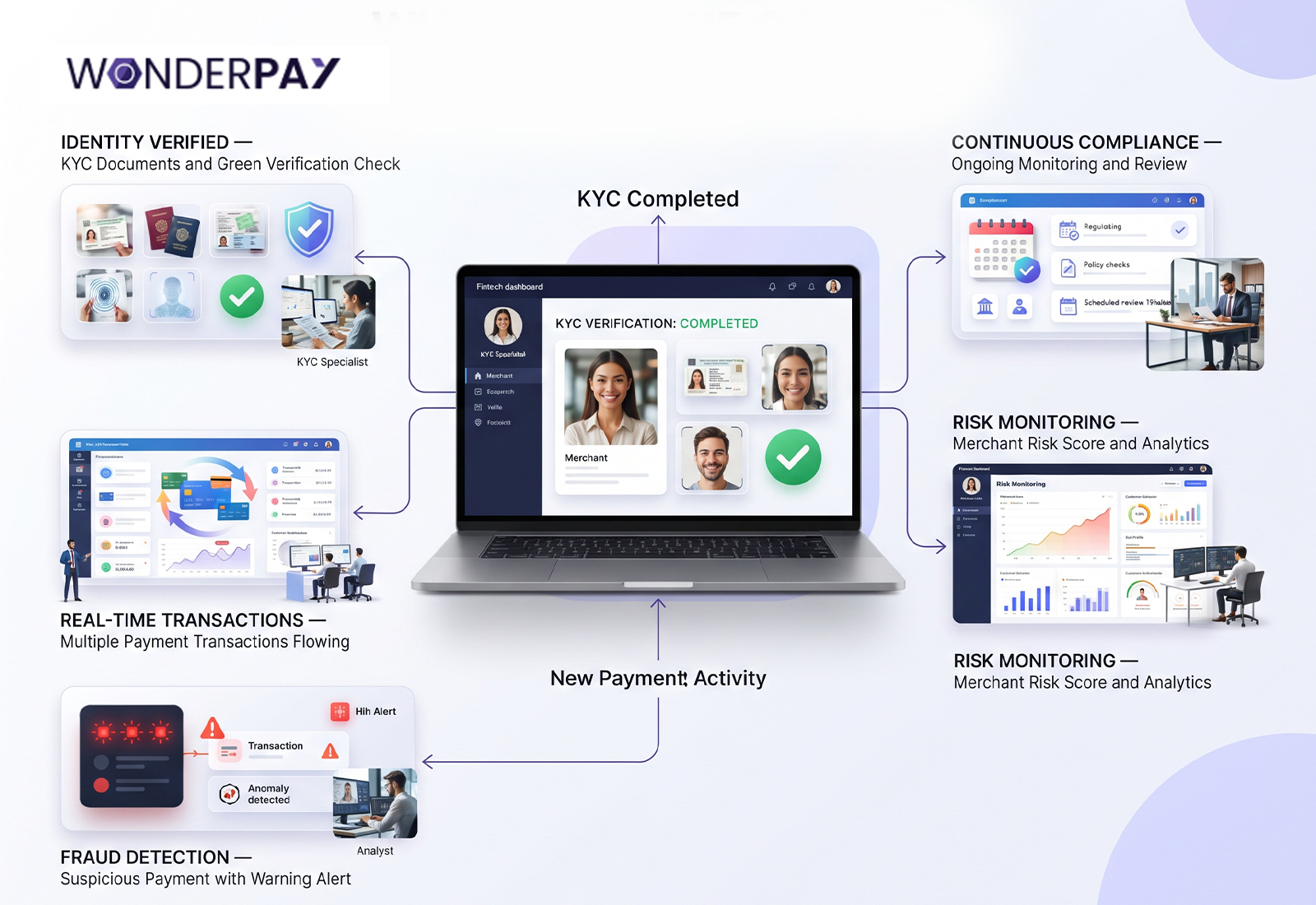
While KYC is an incredibly robust first line of defence against fraudulent onboarding, it cannot predict how a merchant will behave in the future once approved. Transaction volumes fluctuate, ownership structures can be revised, businesses grow into new services; cybercriminals evolve their fraud methods. This means that passing all their merchant risk management on one-time verifications will leave gaps. Continuous monitoring plugs in those gaps by enabling payment gateways to call out any new risks, long before they impact customers or the global payment ecosystem.
After onboarding, the risk profile of a merchant may change further if they expand their business, change ownership or introduce new products and there are also instances where transaction volume spikes unexpectedly. Without constantly monitoring these changes can go unnoticed until fraud, chargebacks or compliance problems occur. With continuous monitoring, payment gateways can identify potential risks and respond effectively.
Digital payment fraud is ever-evolving, with criminals using tactics as account takeovers, synthetic identities and transaction patterns that seem suspicious. KYC performs this screening on merchants only at the time of onboarding, allowing these new fraud trends to go undetected later. Constant monitoring of the merchants ensures that you identify suspicious activities at the early stages and fortify your fraud detection mechanisms.
The RBI mandates regulated entities to form a risk-based approach in undertaking continuous customer due diligence, on an ongoing basis throughout the course of the business relationship. Payment gateways should keep an eye on the transactional footprint of merchants, update customer information when necessary and flag activities not aligning with the merchant’s profile to stay in compliance and mitigate financial crime risks.
Learn how the RBI’s latest payment roadmap can help MSMEs embrace faster, safer, and more inclusive digital payments by reading RBI’s Payment Vision 2028.
Continuous merchant monitoring guarantees that a merchant stays compliant and works below acceptable risk levels during the business relationship, while KYC checks a merchant prior to onboarding. Payment gateways can monitor merchant activity, spot suspicious behavior, and address possible problems before they have an impact on consumers, companies, or the payment ecosystem thanks to this continuous process. Continuous monitoring has emerged as a crucial component of efficient merchant risk management as fraud strategies continue to change.
Continuous merchant monitoring is an ongoing analysis of factors such as merchant data, transaction patterns, account activity and compliance levels through automated systems with risk assessment tools. Payment gateways monitor for sudden spikes in transactions, unusual refund patterns, high chargeback rates and very often check changes in business information. Alerts are generated when the system detects potential suspicious activities, leading to further investigation of the alerts which helps in taking timely actions thereby eliminating financial or compliance risks.
Continuous monitoring goes beyond transaction analysis and looks at a number of merchant activities such as:
This practice ultimately keeps payment gateways informed about the level of risk posed by each merchant and ensures adherence to increasingly stringent regulatory standards.
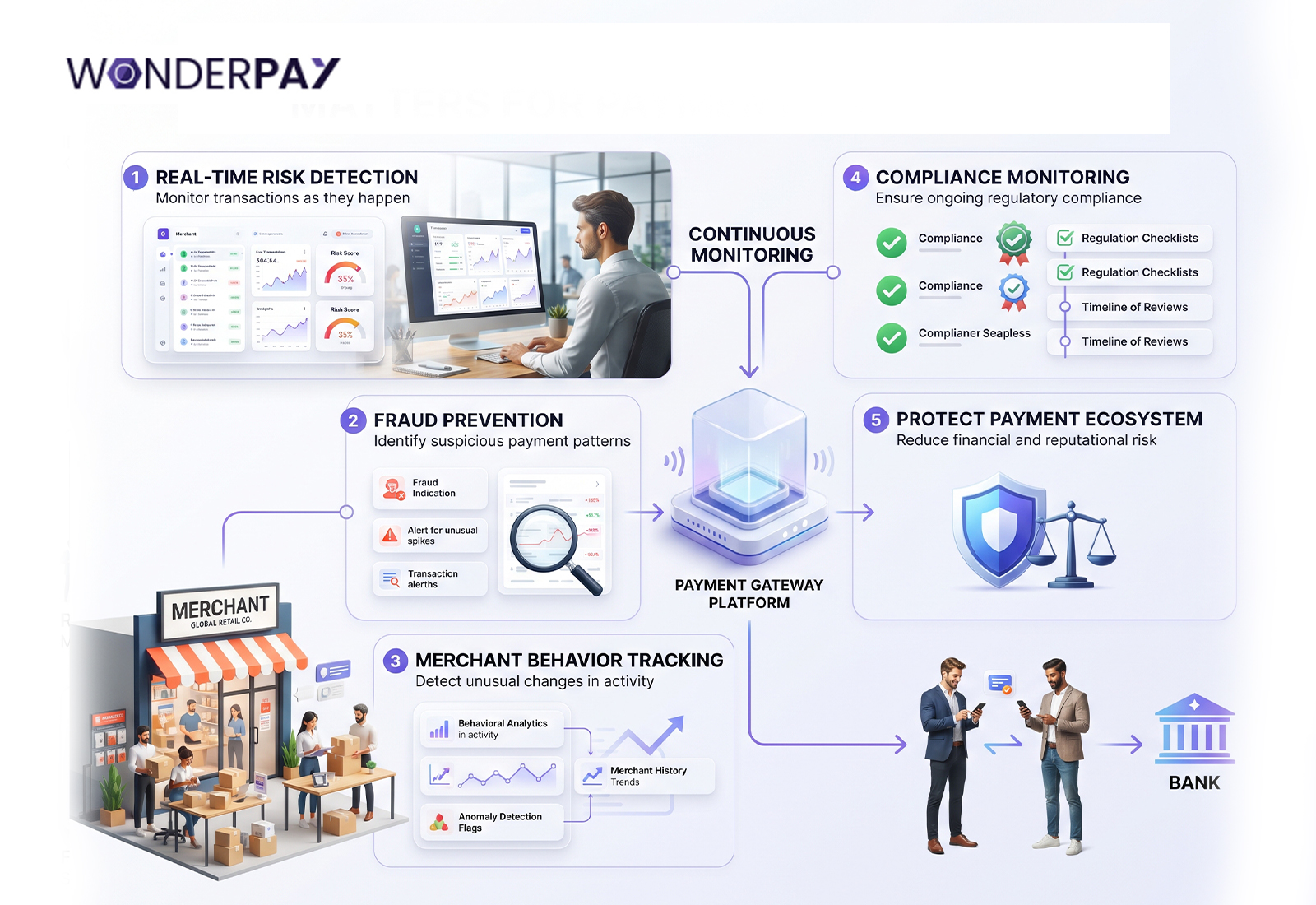
With the growing digital payments ecosystem in India, millions of merchant transactions are being processed daily through payment gateways. It has also elevated the risk of fraud, financial crime, operational risks and compliance challenges on this scale.
Real-time merchant tracking allowing payment gateways to be able to spot these risks proactively, defend consumers, and sustain confidence in digital payments. It also aids organisations to meet regulatory requirements while simultaneously supporting long-term viability of business.
Payment gateways can track such suspicious transactions before it leads to major financial threats around the clock. Unusual payment behavior transactions include sudden spikes in (Previous/ Current) high transaction volumes, too many refunds, multiple failed attempts of purchasing payments or money transfers. Detecting such warning signs early helps payment providers track suspicious or high-risk merchants, suspend deals and mitigate financial losses.
Regulatory compliance continues after merchant onboarding. Payment gateways are anticipated to keep an updated set of merchants, monitor customer activity and help identify transactions that seem inconsistent with a merchant’s declared business profile. Continuous monitoring allows organisations to achieve these obligations and minimise the chances of regulatory breaches or fines.
The KYC framework of RBI emphasizes the necessity of periodic Customer Due Diligence (CDD) and risk-based approach at different points in time during the continuance to a particular customer relationship.
Consumers expect safe and secure payment experiences every time they make an online purchase. Payment gateways are able to detect merchants that are suspicious before any such merchant starts affecting his customers, by focusing on continuous merchant monitoring thus reducing fraudulent payment chargebacks and financial disputes. In addition, a secure payment environment increases customer confidence to adopt digital payment services more widely.
One fraudulent merchant could tarnish the reputation of a payment gateway and lower consumer trust. Moreover, on-going monitoring means payment providers can flag high-risk merchants and act proactively to avert any fraudulent goings-on that could impact the wider payments ecosystem. Proactive steps such as this helps protect brand reputation, reinforce business relationships, and underscore a trial commitment to payment security.
Continuous monitoring of merchants is only possible with the roadmap towards effective systems, technology and compliance. Payment gateways should plan a multi-pronged strategy inclusive of real-time monitoring with scheduled periodic risk assessments to detect and address potential threats before they have a chance to impact the payment ecosystem.
Unlike regular fraud checkers that flag suspicious activities after financial losses, real-time transaction monitoring enables payment gateways to identify these hidden suspicious activities as they happen. They each review and flag transaction behaviour in real-time for further investigation.
Key activities include:
Timely detection enables the risk teams to perform an investigation in relation to suspicious activities found and minimise any potential fraud.
Because businesses change over time, a merchant’s risk profile should be assessed on a regular basis. The merchant may need to be reevaluated if ownership, goods, services, transaction patterns, or geographic activities change.
Payment gateways must to routinely examine:
Details of a business registration.
Monitoring is kept in line with the merchant’s current risk level with the aid of periodic reviews.
Thousands of merchants conduct transactions every day, and manual reviews are insufficient to keep an eye on them. Payment gateways can analyze massive amounts of transaction data, identify behavioral abnormalities, and produce real-time alerts because of automation and artificial intelligence (AI).
Detection of merchants must always aid in compliance with regulations. A payment gateway should ensure continued customer due diligence after onboarding, which can be achieved by continuously updating merchant information and monitoring transactions for any unusual activities.
As per the RBI Master Direction – Know Your Customer (KYC) Directions, regulated entities must implement a risk-based approach that provides for customer due diligence on an ongoing basis during the course of any business relationship.
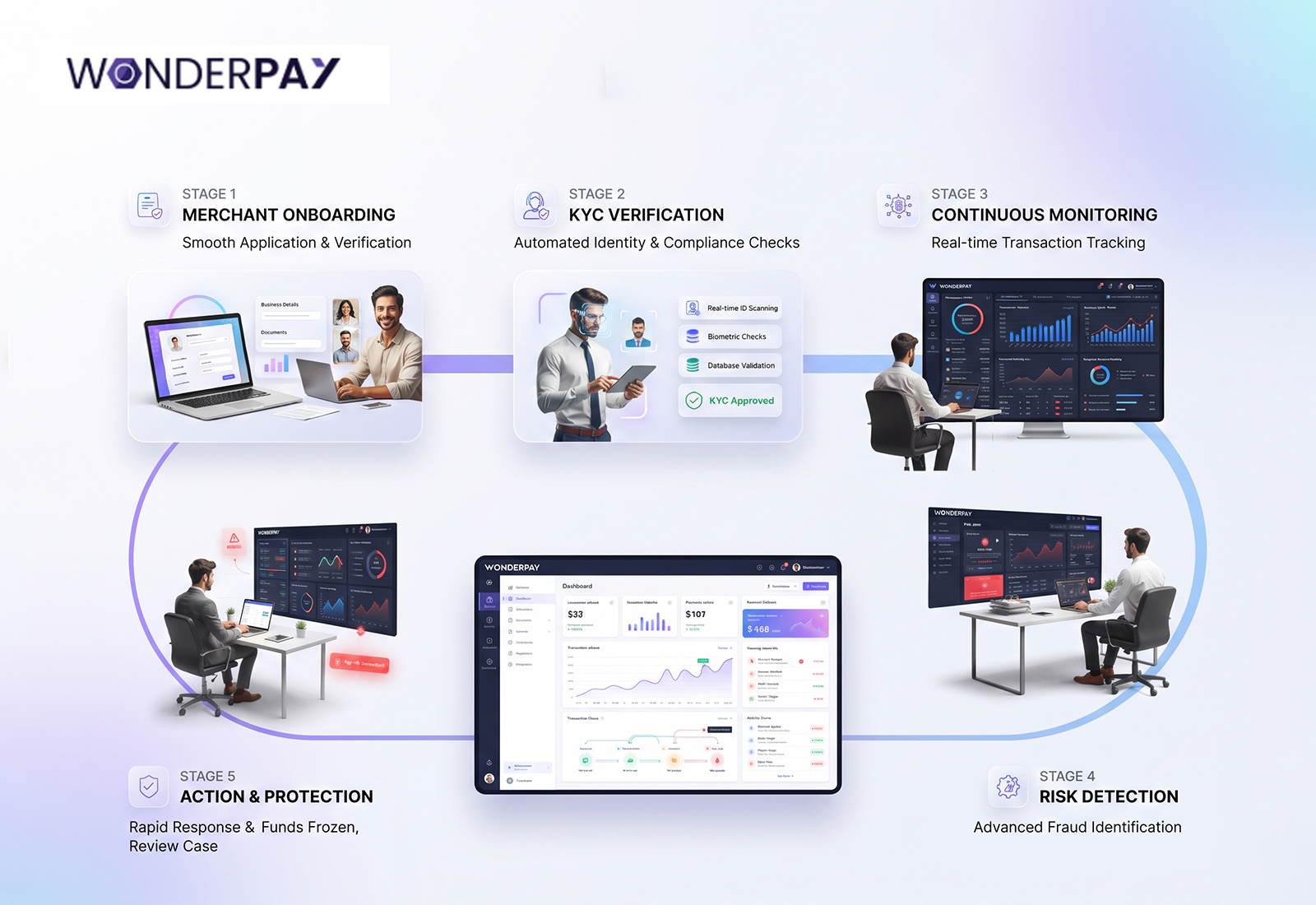
Managing merchant risk requires more than completing KYC during onboarding. Secure merchant verification, ongoing monitoring, and robust payment infrastructure are essential for businesses to have a payment gateway. Together, these features enable businesses to reduce fraud, streamline their operations, and ensure adherence to regulatory standards.
Merchants can easily be onboarded using an efficient KYC process and document verification with Wonderpay. It allows companies to enable real merchants to join the platform swiftly while adhering to relevant regulatory rules.
Once a merchant has been on-boarded, risks keep changing. Wonderpay keeps a close eye on the merchant’s activity, watching for suspicious transactions, too many refunds, a high rate of chargebacks, and more. This preventive approach ensures businesses identify risks at an early stage and make appropriate timely corrections.
Wonderpay complies with industry best practices for secure payments and merchant risk management. As part of this compliance process, businesses will be better equipped to handle compliance regulations and minimize risk of financial crime through continuous monitoring and robust verification.
Handling larger numbers of transactions can become more complex as businesses expand. Through its scalable payment solutions, Wonderpay enables organisations to handle increased transaction volumes efficiently, securely, and with full merchant control.
While KYC is a crucial initial stage of merchant onboarding, it doesn’t prevent risks from appearing after a merchant begins transactions. Continuous monitoring of merchants helps businesses detect suspicious transactions, adapt to evolving merchant behavior, enhance regulatory measures, and mitigate financial losses. With comprehensive KYC measures and continuous risk assessments, payment gateways can build a more secure, compliant, and trustworthy payment ecosystem.
Partnering with a payment provider such as Wonderpay further solidifies this strategy by ensuring secure payment onboarding, ongoing risk management, and scalable payment solutions for expanding businesses.
Want to be a part of the Wonderpay community? follow us on:
Youtube: https://www.youtube.com/@wonderpaytec
Instagram: https://www.instagram.com/wonderpaytec
LinkedIn: https://in.linkedin.com/company/wonderpay-technologies-pvt-ltd
Facebook: https://www.facebook.com/wonderpaytec
Twitter: https://x.com/wonderpaytec
Merchant monitoring is an ongoing process of monitoring post merchant onboarding and reviewing the merchant’s transactions, business activities, and behaviour continuously. It assists payment gateways in identifying suspicious activity, reducing fraud, staying in compliance with regulations, and addressing the changing risks of merchants during the entire business relationship.
KYC validates a merchant during the onboarding process. It is unable to identify changes in the business, ownership or transaction activities, or new fraud methods. Continuous merchant monitoring offers real-time insights into merchant behavior and enables payment gateways to detect potential threats before they escalate into problems.
Any sudden surge in transaction volume, a high chargeback ratio, unusual refunds, failed transactions, changes to business data, and unusual business activity should be tracked by payment gateways and alerted to any use that the merchant did not declare as being part of their business. These indicators can be a sign of fraud or greater compliance risk.
The KYC policy of RBI is a risk-based policy that involves continuous customer due diligence during the trading relationship. Regular merchant monitoring assists payment gateways keep merchant data up to date, track transaction history and spot suspicious activity for regulatory compliance.
Through merchant onboarding and secure transactions, continuous transaction monitoring, scalable payment infrastructure and compliance-focused payment solutions, Wonderpay helps businesses thrive. These features can help businesses minimize fraud risks, streamline processes, and enhance the security of digital payments.

“A fintech content specialist with expertise in financial technology, digital banking, and emerging market trends, Kanisha Mathur is skilled in crafting SEO-friendly, research-driven content that transforms complex financial concepts into engaging and accessible insights. Combining analytical precision with compelling storytelling, the writing delivers value to both industry professionals and modern digital audiences.”