What Are P2P Payments? Meaning, Working, and Benefits
November 21, 2026
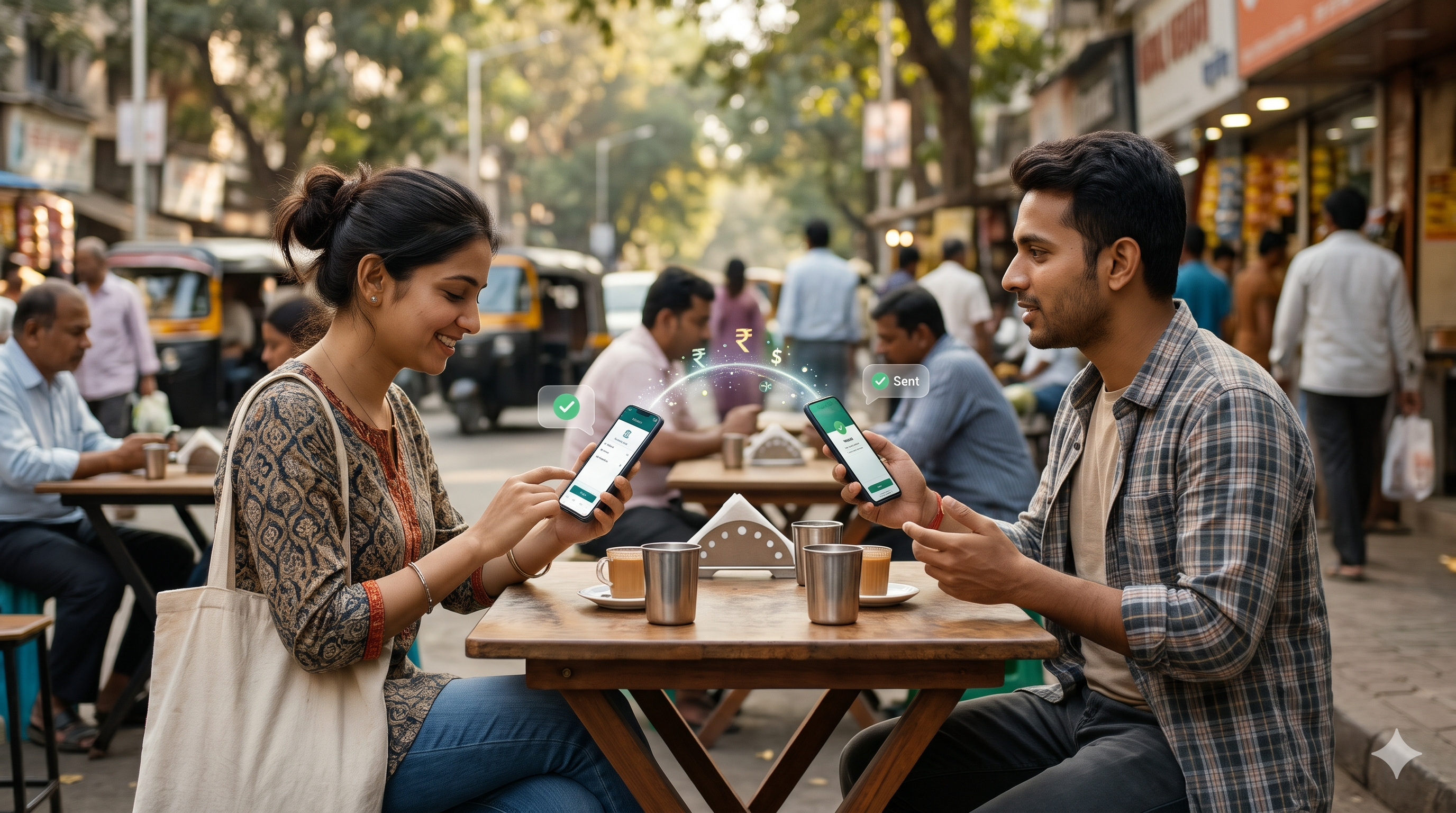
Last week, Arjun sent ₹500 to his brother for their mother’s birthday gift. He opened his phone, picked his brother’s name, and tapped send. The money transferred in seconds, and his brother replied with a thumbs-up before Arjun had even locked the screen.
The experience includes some simple steps, i.e., enter the amount, type the PIN, and tap on send; done. That expectation is why person-to-person (P2P) payment in India matters to individuals.
The scale backs this up. NPCI figures for October 2026 show UPI handling 25.47 billion transactions in a single month, and a large share were one individual paying another.
This guide explains how the technology works, what the data shows, where the risks sit, and other relevant information you must know.
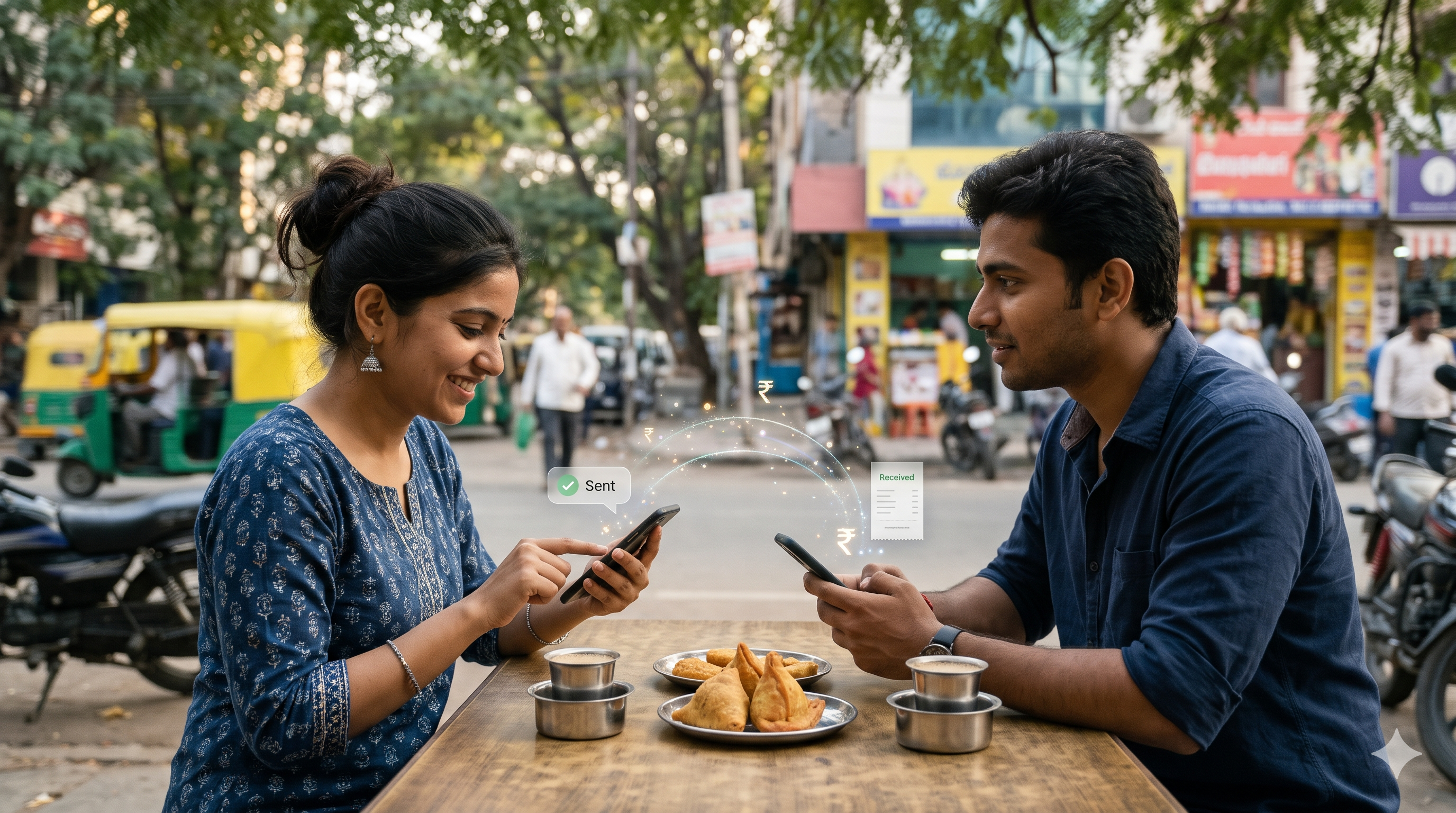
P2P stands for peer-to-peer: A digital payment sent directly from one individual to another, rather than to a shop or company. A dinner-bill share, rent, a tutor’s fee and money sent home all qualify. The sender usually needs only a mobile number, a UPI ID or a QR code, and the money moves through an app, net banking or a wallet.
Banks remain involved. The app is the front desk, and the plumbing unde rneath is the Unified Payments Interface (UPI), built by the National Payments Corporation of India (NPCI) and operating within the Reserve Bank of India’s (RBI) framework. Any p2p payment system in India is a layer on that banking network, not a replacement for it.
The distinction matters to sellers. Customers often pay small businesses with the same scan-and-confirm flow they use with friends, which blurs personal and business transfers. Understanding the p2p payment meaning helps a seller pick the right collection tool.
(source)
A transfer feels instant to the person tapping the screen, but several checks happen in the few seconds between the tap and the confirmation. Understanding them explains both the speed and the safety rules.
The sender starts the payment. The sender opens the app and picks the recipient.
The app checks the payee. Before any money moves, the app asks the network to confirm the recipient and displays the registered name. This is the sender’s chance to catch a wrong digit.
The sender enters the amount and authenticates. The amount, plus an optional note such as “March rent”, is entered, and the sender confirms with a UPI PIN. Depending on the method, an OTP or biometric check may be added. The note helps both sides reconcile later, and the amount deserves a final look because a completed UPI transfer cannot be recalled by the sender.
The network processes the instruction. The request travels in encrypted form to the bank that sponsors the app, then to NPCI’s central switch, and on to the recipient’s bank.
Funds move and both sides get confirmation. The sender’s bank debits the account, the recipient’s bank credits it, and both parties receive an alert with a transaction reference number. That number is the proof of payment and the key detail for any complaint.
Because every UPI app uses the same switch, any app can pay any other. If a debit succeeds but the credit fails, the amount should return automatically under RBI’s turnaround-time rules. If it does not, complain to the app first, then the bank, then RBI’s Integrated Ombudsman Scheme.
Also read: UPI Charges From October 15, 2026: New MDR Rules Explained
India is the clearest case study of peer-to-peer transfers working at national scale. The official numbers, from NPCI and the Reserve Bank of India, show how fast the habit has spread.
NPCI figures for October 2026, as reported by Entrepreneur India, show a record 25.47 billion UPI transactions worth ₹31.53 lakh crore, up 23% in volume and 16% in value year on year. The daily average was about 822 million transactions and ₹1,01,707 crore.
(source)
The RBI-DPI, which sets March 2018 at 100, reached 516.76 for September 2025 according to the RBI’s release of February 2026, up from 465.33 a year earlier.
(Source)
TaxTMI’s summary of NPCI statistics puts person-to-merchant (P2M) payments at about 63% of UPI volume in the first half of 2025, leaving more than a third as person-to-person activity.
On 15 September 2026, the government and NPCI set out a revised framework. Business Today reported that transfers between individuals stay free irrespective of the amount, while a 0.4% merchant discount rate (MDR) applies only to specified merchant payments above ₹2,000, capped at ₹300 for transactions of ₹75,000 and above. The rollout was reportedly deferred, and Business Standard later reported NPCI defending the MDR in a Supreme Court filing, so confirm the current status on NPCI’s website before pricing.
(Source)
A handful of design choices separate a modern peer-to-peer transfer from the cheque, demand draft or counter deposit that came before it. Each one explains part of why adoption spread so quickly.
Speed: On a UPI-based p2p payment system, most transfers settle within seconds, though timing varies with the bank and network.
Always on: UPI runs every day of the year, including holidays and late nights.
Interoperability: Any UPI app can pay any other, so nobody has to join a particular platform.
Authentication: A PIN plus a phone bound to the registered number protects each payment.
Records: Time-stamped reference numbers help with budgeting, disputes and GST bookkeeping.
Limits: For most personal transfers the per-transaction cap is generally ₹1 lakh, so check your bank and app.
Individuals gain convenience and less cash handling. Small businesses gain faster access to funds and cleaner books, and many p2p payment services also let a seller share a payment link straight from a chat.
Most Indians use several providers without noticing. UPI apps such as PhonePe, Google Pay and Paytm add bill payments and recharges to simple transfers, BHIM is the NPCI-backed app with a deliberately simple interface, and Amazon Pay offers UPI within its shopping ecosystem. Most banks offer UPI inside their own apps, and Bajaj Finance offers Bajaj Pay UPI.
Prepaid wallets allow instant transfers but lack the deposit insurance that banks carry, so keep balances small. Freelancers billing overseas clients often use PayPal. Modern p2p payment services now extend beyond transfers to QR codes, payment links, scheduled payments and statements for tax records.
Generally yes on legitimate apps. The p2p payment system relies on encryption, two-layer authentication, fraud monitoring and RBI and NPCI grievance rules, so most losses come from social engineering rather than technical failure. Common tricks include the fake collect request, where approving with your PIN sends money out instead of in, and the edited screenshot of a payment that never arrived.
Enter your PIN only to send money, never share OTPs, read the recipient’s name before approving and check your balance, not a screenshot. If something goes wrong, report it to your bank and the app, call 1930 and file a complaint at cybercrime.gov.in. RBI’s liability rules for unauthorised transactions favour customers who report promptly.
These three terms are often used as if they meant the same thing. They do not, and mixing them up is one of the most common mistakes small sellers make.
P2P (person to person): money moves between two individuals, such as a friend repaying a loan.
P2M (person to merchant): a customer pays a business, typically by scanning a shop’s QR code or paying through a UPI app at checkout.
Payment gateway: a service that lets a business accept online payments through cards, UPI, wallets and net banking, with refunds, settlement reports and reconciliation built in.
UPI itself supports both P2P and P2M. Sending money to a friend is P2P. Paying a grocery store is P2M. The same app and the same rail are used in both cases.
| Payment Type | Who Pays Whom | Typical Use | Business Tools Included |
|---|---|---|---|
| P2P | Individual to Individual | Repaying a friend, sending money online | None |
| P2M | Customer to Merchant | Paying at a shop or app | QR codes, merchant accounts |
| Payment Gateway | Customer to Business, online | Website or app checkout | Refunds, reports, reconciliation, multiple payment modes |
Convenience always comes with trade-offs. Some risks fall on everyone who sends money, and others matter mainly to businesses that rely on these transfers for income.
Fraud and scams. Fake collect requests, impersonation calls, phishing links and edited payment screenshots can all lead to losses.
Wrong-recipient errors. A mistyped number or ID sends money to a stranger, and getting it back depends on that person’s cooperation and on bank processes.
Failed or pending transactions. Network problems or bank downtime can leave a payment in limbo for a short while before it is reversed or completed.
Limited dispute options. Unlike a card purchase from a merchant, a transfer to an individual does not always come with a built-in refund or chargeback route, so checking details beforehand matters.
Privacy concerns. Sharing a UPI ID or number is usually harmless, but sharing credentials or screenshots of banking apps is not. Third-party apps also need access to sensitive financial information, so install only from official stores.
Not built for high-value or bulk payments. Transfer caps and the lack of bulk-payment tools make personal-grade apps unsuitable for large B2B settlements.
Weak integrations. Many apps offer limited links to accounting software, which makes reconciliation, payroll and expense tracking slow.
Fees on some services. Personal use is generally free, but business accounts on some platforms can pay for instant payouts, currency conversion or card-funded transfers.
Limited protection for stored balances. Wallet balances are not insured like bank deposits, so a service disruption can lock funds temporarily.
Geographic limits. Some services work only in particular countries, which restricts sellers with overseas customers.
Peer-to-peer transfers involve individuals, but the technology behind them has reshaped what customers expect from any business. A seller who understands that link can use it without confusing personal transfers with proper merchant payments.
A shopper who pays a friend in five seconds will not enjoy a checkout that asks for a card number, billing address and an OTP on top. Offering familiar p2p payment solutions removes that friction. Razorpay’s guide notes that fast, familiar payment options help reduce cart abandonment at checkout.
A real-time p2p payment system puts money in the account within seconds instead of days. A small business can then pay a supplier, an employee or a delivery partner on the same afternoon, which matters most for cash-tight operations such as restaurants, salons and local retail.
Person-to-person transfers are generally free for the sender, and digital collection reduces the costs of counting, storing and depositing cash. For payments above ₹2,000, merchants should keep the revised MDR framework in mind, since it applies to specified merchant transactions and not to personal transfers.
QR codes: A UPI QR code at the counter lets customers scan and pay in seconds. It suits shops, cafes and clinics.
Payment links: A link sent over WhatsApp, SMS or email lets freelancers and service providers collect fees remotely.
Digital wallets: Wallet acceptance gives customers who prefer stored balances another option.
Checkout integration: Online stores can add UPI, cards and wallets at checkout through a payment gateway, so buyers pay without leaving the page.
With an average of about ₹1 lakh crore moving through UPI every day in October 2026, a business that cannot accept UPI is invisible to a large part of its market.
Personal-grade transfer tools work for small, informal amounts. As sales grow, businesses usually need merchant QR codes, payment links and gateway features such as refunds, reports and reconciliation. The sensible approach is to use each tool for the job it was built for.
Small habits prevent most losses. The checklists below separate what senders should do from what sellers receiving money should do.
Peer-to-peer transfers have moved from convenience to expectation, and NPCI and RBI data show that p2p payments in India are now the default way to move small sums. For businesses, the lesson is balance: accept familiar transfers, add merchant QR codes and payment links, and bring in a gateway when refunds and reconciliation matter.
Want to be a part of the Wonderpay community? follow us on:
Youtube: https://www.youtube.com/@wonderpaytec
Instagram: https://www.instagram.com/wonderpaytec
LinkedIn: https://in.linkedin.com/company/wonderpay-technologies-pvt-ltd
Facebook: https://www.facebook.com/wonderpaytec
Twitter: https://x.com/wonderpaytec
A digital exchange of funds from one individual’s bank account or digital currency wallet to the other individual’s via an application. The majority of such fund exchanges in India occur through UPI using PhonePe, Google Pay, Paytm, BHIM and additional peer-to-peer (p2p) payment services.
The sender selects the recipient, provides the amount and approves the transaction using a UPI PIN. Once the transaction request goes through the sponsor bank and the National Payments Corporation of India (NPCI) switch to the recipient’s bank, both parties will receive confirmation within seconds.
Yes, if you use a regulated app, as long as you keep your PIN/OTP secure, confirm the identity of the person receiving the funds, and do not accept unexpected requests for payment from others. Report fraudulent activity to your bank immediately, call 1930, and file a formal report on cybercrime.gov.in.
Transfers between individuals have generally been free for the sender, and the revised framework keeps them free irrespective of the amount. The 0.4% MDR applies only to specified merchant payments above ₹2,000 and its rollout has been in flux. The per-transaction cap for most personal transfers is generally ₹1 lakh.
Individuals can use peer-to-peer (P2P) payments as a convenient way to transfer funds instantly, with very little cost associated with each transfer, and as an easily accessible method for people to pay for things together, such as splitting bills or sharing expenses, or to send money to someone else at any time.

“A fintech content specialist with expertise in financial technology, digital banking, and emerging market trends, Kanisha Mathur is skilled in crafting SEO-friendly, research-driven content that transforms complex financial concepts into engaging and accessible insights. Combining analytical precision with compelling storytelling, the writing delivers value to both industry professionals and modern digital audiences.”